A flower blanket is made the way a garden grows: one bloom at a time, across many sessions, with the full picture emerging slowly and only becoming visible at a certain scale. A blanket of fifty flowers requires fifty sessions of flower-making, each session its own small completion, each flower its own small achievement. The maker who begins a flower blanket in spring and finishes it in late summer has spent a season making something, and the blanket carries that season in it the way a garden carries the season in which it was tended. There is no shortcut in a flower blanket. The flower count is what it is, and each one requires the time it requires, and this is not a problem with the format. It is the format’s central quality. The blanket takes time because the garden takes time, and both are worth it.
This list covers 18 crochet flower blanket patterns from the simplest single-motif repeat to the most elaborate mixed-species garden compositions, each with notes on what the making process is like, what the maker’s attention is asked to do, and what the finished blanket returns to the room it lives in.
1. Simple Daisy Field Blanket
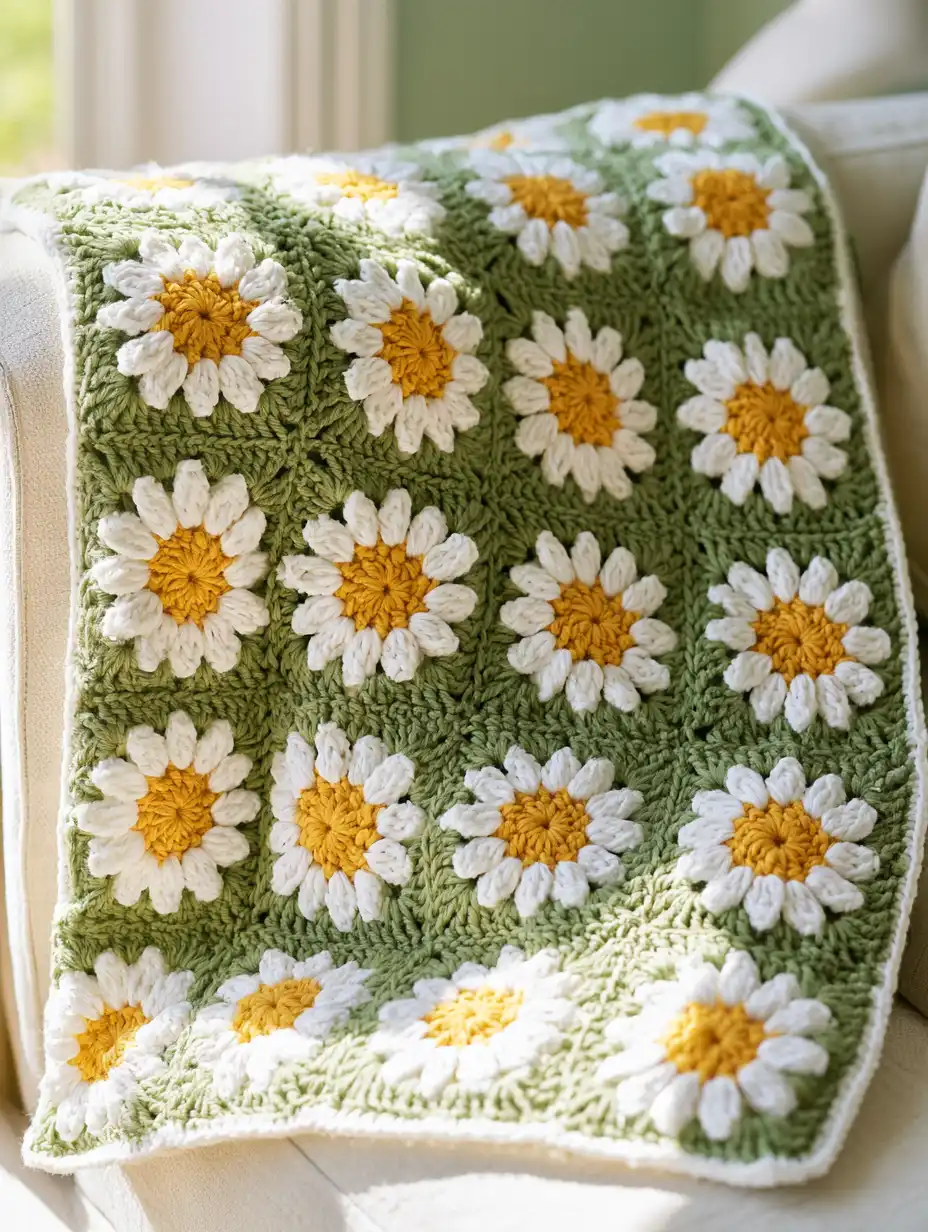
A blanket assembled from identical daisy motifs, each worked as a flat eight-petal flower with a raised center, joined in a grid arrangement on a background of solid single crochet squares in a fresh green. The daisy field blanket is the meditative entry point into the flower blanket format because every motif is the same and the only variable from session to session is the color assigned to each daisy’s petals.
In bright white daisies with vivid warm yellow centers on a fresh spring green background the simple daisy field blanket reads as a field of daisies seen from above, which is the specific quality of lying in long grass on a summer afternoon when the daisies are at eye level and the sky is above and there is nowhere else to be. The uniformity of the daisy motif is not a limitation. It is what makes the blanket meditative to produce: once the daisy pattern is learned, which takes the first three flowers, the hands know what to do and the mind is free to be present with the making rather than occupied by it. A blanket of sixty daisies in three sizes of the same session is sixty sessions of quiet attention. Each session ends with one more daisy. The field grows.
Yarn: DK weight in bright white for petals, vivid yellow for centers, fresh spring green for background
Hook: 4 mm
Flower count: 60 to 80 daisies for a throw
Making quality: Highly meditative once the motif pattern is learned. One flower per session is a sustainable pace
Room quality added: A daisy field blanket on a sofa brings the specific cheerfulness of an early summer meadow into an interior regardless of the season outside
2. Wildflower Meadow Blanket
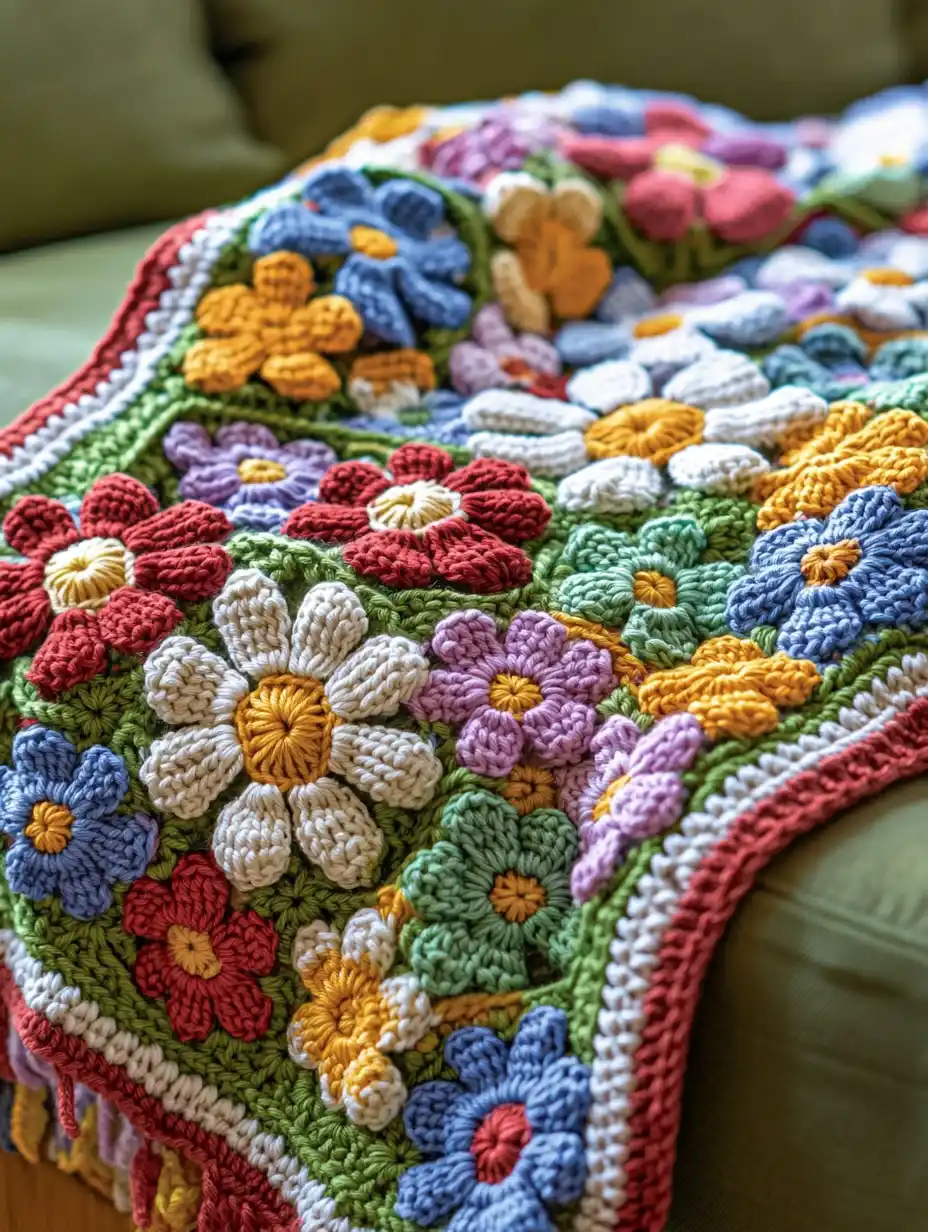
A blanket assembled from multiple different flower species, each worked as a distinct motif, arranged across the blanket surface in the irregular, mixed distribution of a real wildflower meadow. Daisies alongside cornflowers alongside poppies alongside meadow buttercups alongside small clover heads, each species in its accurate color, distributed without pattern across the blanket ground.
The wildflower meadow blanket is the flower blanket that most rewards the making process as a study in botanical observation, because producing each different species requires the maker to notice what makes each flower distinctly itself. The daisy has eight petals and a raised center. The cornflower has ray florets around a dense disc. The poppy has four broad slightly crumpled petals and a near-black center. The buttercup has five glossy petals of a specific warm yellow. Each flower requires a different pattern and a different set of color decisions, and learning each one is a small act of attention to the natural world that the blanket then carries permanently. The finished blanket is a record of everything the maker paid attention to during its making.
Yarn: DK weight in species-accurate colors for five to seven flower types, fresh green for meadow background
Hook: 4 mm
Flower count: 80 to 120 mixed species for a throw
Making quality: Varied and engaging across the full project because each species requires a different pattern. No two sessions are identical
Room quality added: The wildflower meadow blanket brings the specific biological richness of a diverse meadow into a room. It is the blanket that invites looking closely
3. Granny Rose Blanket
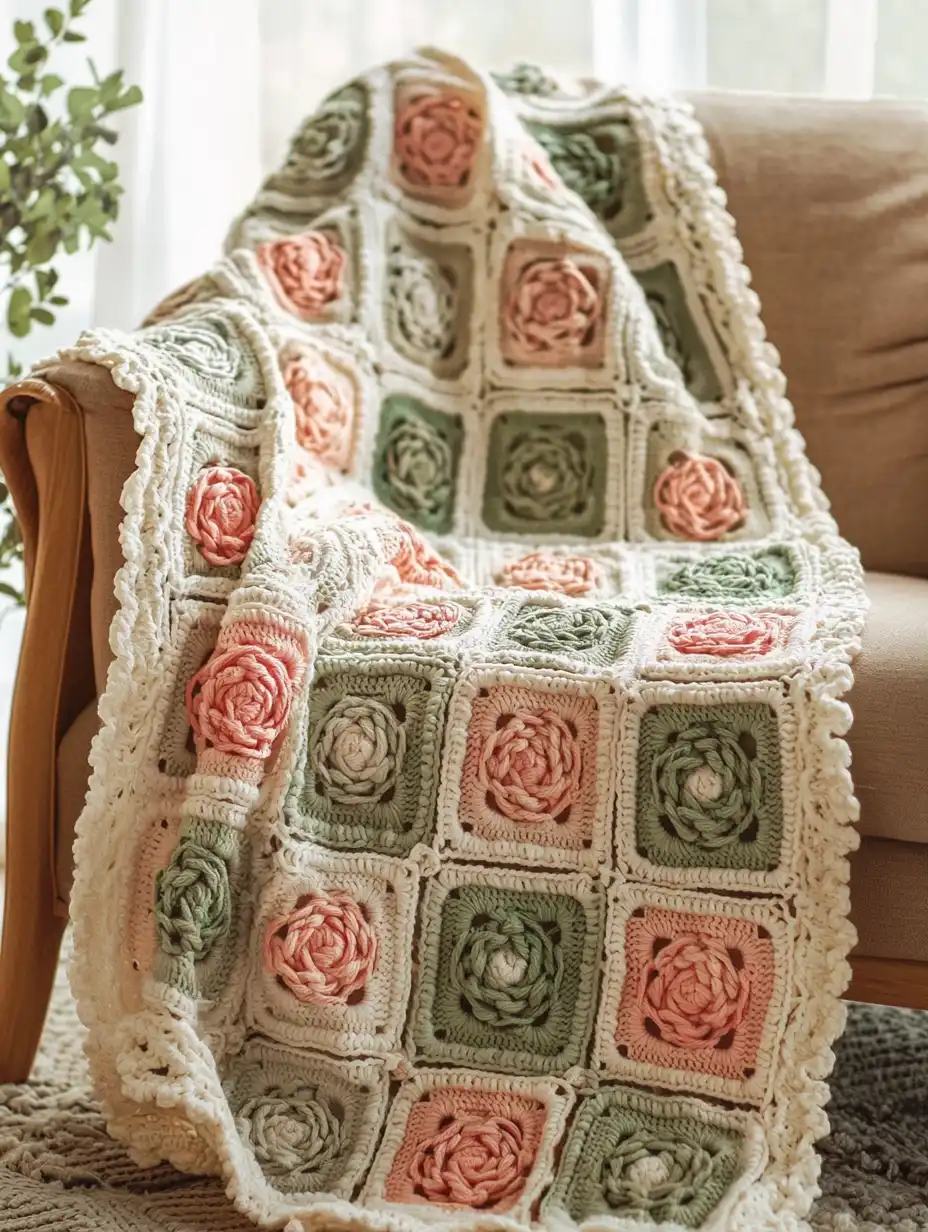
A blanket assembled from traditional granny squares whose center motif is a small spiral rose in place of the standard cluster center, each square framed by two or three rounds of coordinating solid color. The rose granny square is the oldest version of the flower blanket format and the one with the deepest domestic history, produced in this form across many generations of makers who understood the granny square as a frame for a small flower.
In soft blush roses in squares framed by natural cream and warm sage the granny rose blanket reads as the most domestic and the most accumulated of the flower blankets on this list, the blanket that looks as if it was assembled from squares made across a decade rather than in a single project. This reading comes from the granny square format’s deep cultural familiarity: a blanket of rose-center granny squares reads as an heirloom before it is finished because the format carries the memory of every granny square blanket that has been used on a sofa or a bed and washed and used again. Make the roses in a color that matters. The rose color is what the maker will look at for as long as the blanket is used, and it should be one that makes the maker glad every time.
Yarn: DK weight in rose color, framing color, and accent color
Hook: 4 mm
Flower count: One rose per square, 80 to 120 squares for a throw
Making quality: The granny square format distributes the making into fully portable sessions. Each square is a fifteen-minute self-contained unit
Room quality added: The granny rose blanket on a chair or sofa reads as specifically loved and specifically domestic in the way that only objects with a design history behind them can read
4. Sunflower Garden Blanket

A blanket assembled from large sunflower motifs, each worked as a full twelve-to-sixteen-petal flower with a deeply textured bobble center, joined directly without a background ground so the sunflowers touch each other at their outer petal edges. The sunflower garden blanket is the most structurally ambitious of the simpler flower blankets because the motif-to-motif joining without a background ground requires each sunflower to be precisely sized so the joins are consistent.
In vivid warm yellow sunflowers with deep warm brown bobble centers joined directly in a grid the sunflower garden blanket produces the specific reading of a sunflower field rather than a garden: the flowers filling the entire visual field without background, each one touching the next, the density of a real August sunflower field where the flowers crowd the space and the sky is visible only at the top of the frame. The bobble texture of each center is the detail that most determines whether the blanket reads as a sunflower garden or as a yellow-and-brown blanket. Each bobble must be pulled through firmly and consistently to produce a center that reads as a sunflower seed head from across the room. Work each bobble round at a tighter tension than the petal rounds.
Yarn: DK weight in vivid warm yellow for petals, deep warm brown for centers
Hook: 4 mm
Flower count: 25 to 36 large sunflower motifs for a throw
Making quality: Each sunflower takes thirty to forty-five minutes, making this the fastest large-motif flower blanket on this list
Room quality added: The sunflower garden blanket adds the specific late-summer energy of a sunflower field to a room. It is impossible to look at it and feel nothing about August
5. Peony Garden Blanket

A blanket assembled from large peony motifs worked in multiple rounds of progressively longer petals, each peony in a different shade of pink from blush to deep magenta, with small leaf squares in deep green placed at each peony’s corner to provide the botanical context the flowers require. The peony blanket is the most lush and the most fully summer of all the flower blankets on this list.
A peony requires patience in a way that a daisy does not. The five-round peony motif in the peony garden blanket takes longer per flower than any other motif on this list and produces the most visually dense flower, with the innermost petals overlapping the middle petals and the middle petals overlapping the outer petals in a layered structure that reads as genuinely floral rather than as a geometric approximation of a flower. The patience the peony asks for is the patience of watching a peony open from its tight bud over several days in a garden: the same slow revelation of layers, the same eventual fullness. A blanket of twenty-four peonies in a tonal pink palette from palest blush through warm rose through deep magenta is a record of the time it took to make them and a promise that the time was not wasted.
Yarn: DK weight in six to eight tonal pink shades from palest blush to deep magenta, deep green for leaf squares
Hook: 4 mm
Flower count: 24 to 30 peony motifs for a throw
Making quality: Each peony is a longer session than most flower blanket motifs. The completion of each one is proportionally more satisfying
Room quality added: The peony garden blanket adds the peak summer abundance of a June garden to a room. It is the blanket that makes a room feel like the specific week when the peonies are at their fullest
6. Spring Blossom Blanket
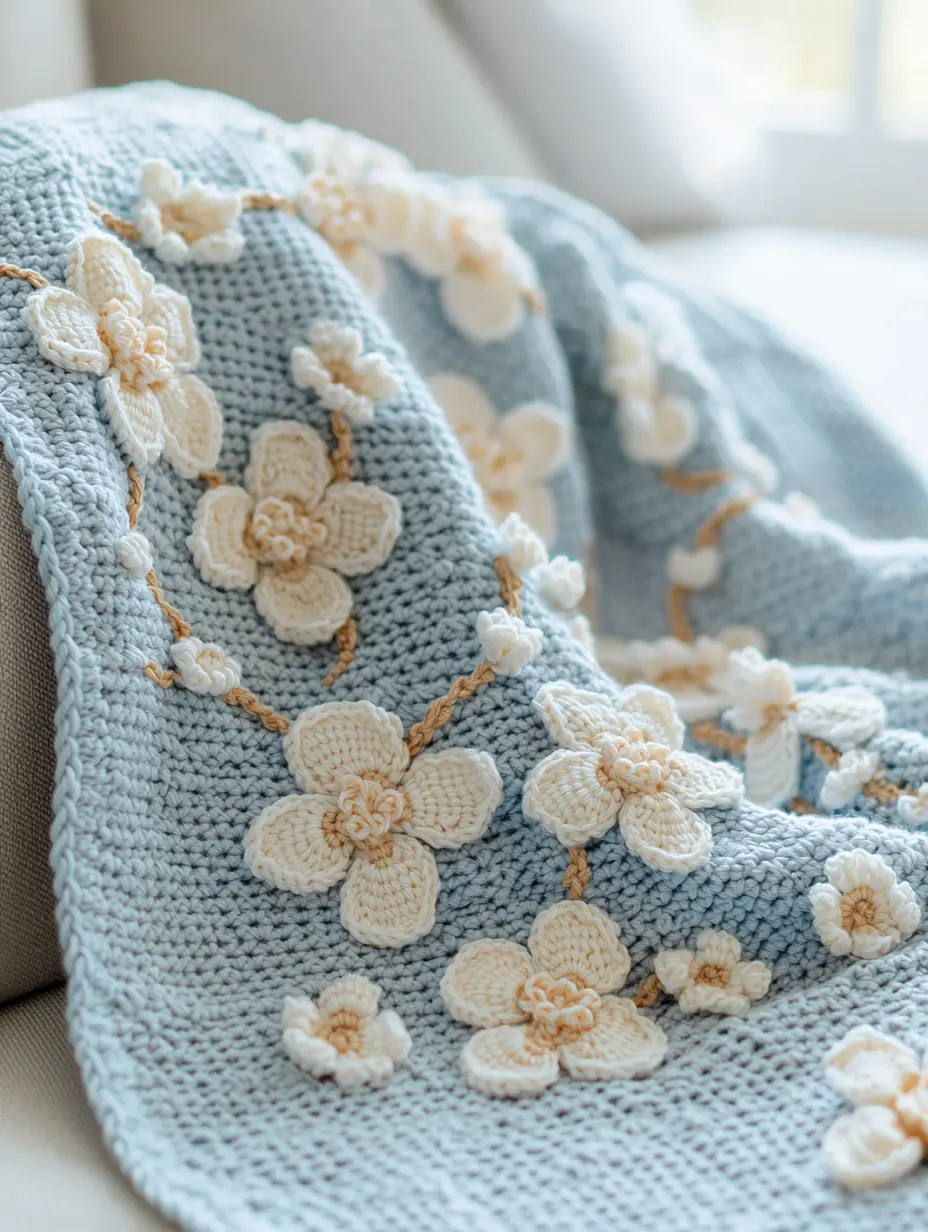
A blanket in a pale background, soft white or the very palest blue, with blossom motifs scattered across its surface in the branch-and-cluster distribution of a flowering tree seen from below, the blossoms in soft blush and palest cream with small brown branch sections connecting clusters. The spring blossom blanket is the blanket for the specific quality of early spring.
The specific quality of early spring that the spring blossom blanket holds is the quality of lying under a flowering tree and looking upward into the blossom against a pale sky, the petals slightly translucent in the light, the branches visible between clusters, the whole thing impossibly beautiful and impossibly brief. The pale background is the sky. The blossom clusters are the blossom clusters. The brown branch sections are the branches. The blanket is the specific view from underneath, made wearable and usable and permanent. A flower blanket that captures a specific seasonal quality this precisely is not merely decorative. It is a record of having noticed something beautiful in the natural world and having decided it was worth the time required to make it permanent.
Yarn: DK weight in palest blue or soft white for background, fine cotton in soft blush and palest cream for blossoms, warm brown for branch sections
Hook: 4 mm for background, 2.5 mm for blossoms
Flower count: 40 to 60 blossom clusters arranged in branch formations
Making quality: The branch-based distribution planning before assembly requires one focused session of layout and planning before the joining begins
Room quality added: The spring blossom blanket brings early spring’s specific light quality into a room. Suitable for any season but most resonant in late winter when the blossom on real trees is still weeks away
7. Lavender Field Blanket

A blanket worked in long vertical rows of lavender sprig motifs on a warm cream background, each sprig a thin stem with small loop-stitch florets along its upper half, the rows close enough that the lavender reads as the dense planting of a Provencal lavender field rather than as individual plants in a garden.
The lavender field blanket is the most linear of the flower blankets on this list, and its linearity is the source of its specific meditative quality: the rows of lavender are worked from the bottom of the blanket upward, each row identical to the last, the field growing one row at a time. The field reading depends on the row density. The lavender rows must be close enough that the stems read as a planting rather than as individual sprigs with space between them. In deep Provencal purple against warm cream the field reads as specifically Provencal, the specific landscape of July in the south of France where the lavender fields are harvested at exactly the right moment and the scent of the cutting carries for kilometers. The blanket holds that landscape in its color.
Yarn: DK weight in warm cream for background, DK in deep Provencal purple for lavender florets, bright green for stems
Hook: 4 mm
Flower count: 15 to 20 lavender rows of 8 to 12 sprigs per row
Making quality: The identical row structure is deeply meditative. Each row is the same as the last and requires only quiet repetition
Room quality added: The lavender field blanket adds a specific aromatic-visual memory to a room. Anyone who has been near a lavender field in bloom recognizes it immediately
8. Rose and Leaf Garden Blanket
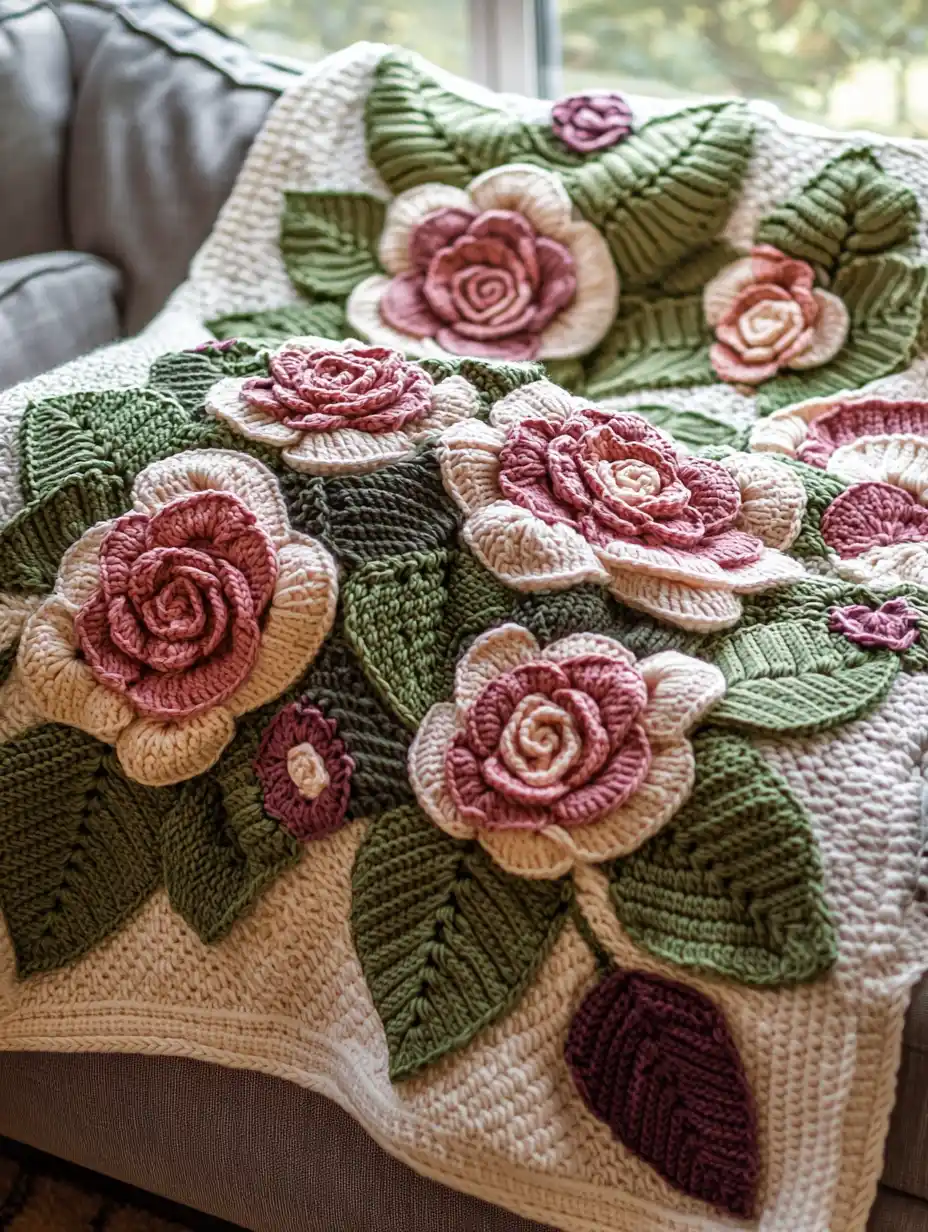
A blanket assembled from alternating rose motifs and leaf motifs in a planned botanical arrangement, the roses in a tonal palette from cream through pink through deep red and the leaves in three different greens. The alternating rose and leaf structure produces a blanket that reads as a specifically designed garden rather than as a field or meadow, the roses and leaves in a considered spatial relationship that could only be the product of deliberate planting.
A rose garden is not a meadow. A meadow is what grows where nothing has been done. A rose garden is the result of someone deciding that roses should grow there and then making that happen through repeated acts of attention over time. The rose and leaf garden blanket carries this distinction in its construction: the alternating rose and leaf arrangement is a planned relationship between flower and foliage, the specific relationship that a rose garden has between its blooms and the leaves that frame them. In a palette that moves from palest cream roses through warm blush through deep rose through burgundy, with deep forest and sage and olive leaves, the blanket reads as a rose garden in full late-summer bloom when every rose is open at once and the leaves are still fresh and green behind them.
Yarn: DK weight in four to six tonal rose colors from cream to burgundy, three greens for leaf motifs
Hook: 4 mm
Flower count: 40 to 50 rose motifs alternating with 50 to 60 leaf motifs
Making quality: The alternating leaf sessions provide a change of pace and pattern from the rose sessions, preventing the repetitive fatigue that a single-motif blanket can produce
Room quality added: The rose and leaf garden blanket adds the specific quality of a cultivated garden to a room. It reads as tended rather than as wild, which is the distinction between a garden and a meadow
9. Hexagon Flower Blanket

A blanket assembled from hexagonal flower motifs, each hexagon worked as a six-petal flower whose petals form the six sides of the hexagon, joined edge to edge in a honeycomb pattern that tiles the blanket surface without gaps. The hexagon flower blanket is the most geometrically satisfying of all the flower blankets because the flower form and the geometric tile are the same object.
The specific satisfaction of the hexagon flower blanket is the satisfaction of a pattern that is simultaneously botanical and mathematical, the flower petal and the hexagon side being the same element read through two different lenses. The tiling of hexagonal motifs without gaps produces a blanket surface that reads as completely covered in flowers with no wasted space between them, which is the reading of a garden at its densest moment in midsummer when every plant is at full growth and the soil between plants has disappeared beneath the foliage and bloom. In a palette of six different colors for six petal sets, each hexagon a different color from its neighbors, the blanket reads as a stained glass garden window. In a tonal palette of related pinks the same construction reads as a garden of roses at different stages of opening.
Yarn: DK weight in multiple colors, one per petal set, or a tonal palette for a more unified reading
Hook: 4 mm
Flower count: 80 to 120 hexagonal flower motifs for a throw
Making quality: The hexagonal join requires attention at each joining point but produces a blanket with no separate joining session, as each motif is joined during its construction
Room quality added: The hexagon flower blanket adds the specific geometric-botanical reading that appeals to a room whose occupant finds beauty in both the natural world and the mathematical structures within it
10. Tulip Garden Blanket
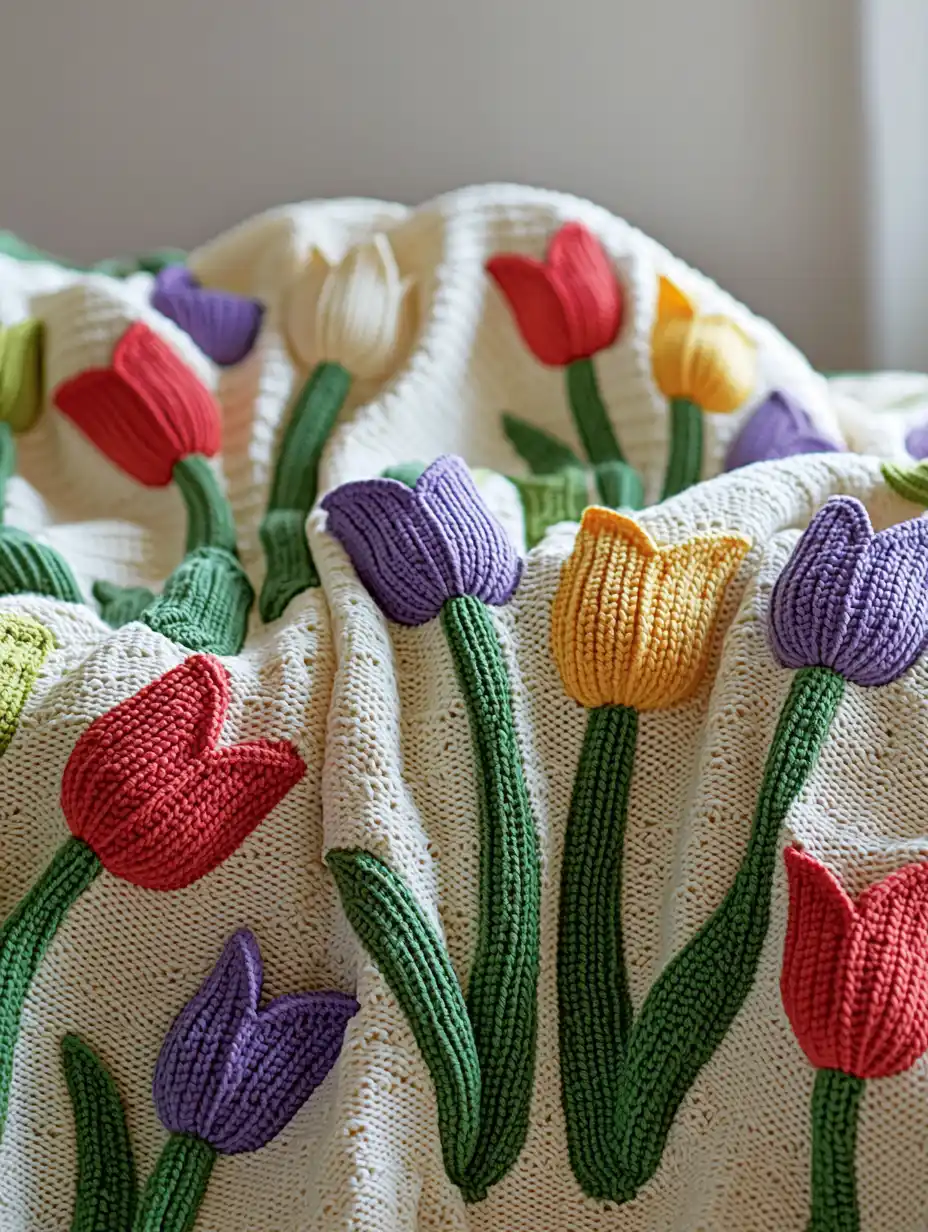
A blanket with tall, upright tulip motifs worked in three-dimensional form with closed cup-shaped petals, each tulip on a green stem with a flat leaf, arranged in rows across a solid background ground as if planted in a formal tulip garden. The tulip blanket is the spring flower blanket, the one for April when the tulip is the flower defining the season.
The tulip motif in the tulip garden blanket is worked as a three-dimensional cup rather than as a flat circle, the petals curving inward at the top to form the characteristic closed tulip form of a tulip that has not yet fully opened. This closed form is botanically essential: a tulip with open petals reads as a generic flower. A tulip with closed cupped petals reads as a tulip in the specific early-to-mid-April stage when tulips are at their most vivid before the petals open and begin to drop. Work the petal tips with a slight inward curve by working the final round at a tighter tension than the lower petal rounds. The inward curve is the single stitch that makes the motif a tulip rather than a flower.
Yarn: DK weight in vivid tulip colors, bright green for stems and leaves, soft cream or pale grey for background
Hook: 4 mm for background, 3.5 mm for tulip petals
Flower count: 40 to 60 tulip motifs in three or four colors arranged in formal rows
Making quality: The three-dimensional tulip cup requires more attention per motif than a flat flower. Each tulip is a more fully occupying session
Room quality added: The tulip garden blanket adds the formal beauty of a spring garden bed to a room. It is the blanket for the person who plans their spring tulip planting in November
11. Poppy Field Blanket

A blanket of vivid scarlet poppy motifs scattered across a fresh green background in the irregular distribution of a wild poppy field, each poppy with four broad petals with slightly ruffled upper edges and a near-black center, the poppies varying slightly in size to suggest the different stages of opening that real poppies in a field display simultaneously.
The poppy carries more meaning than most flowers in the cultural memory of the places where it grows wild, and the poppy field blanket holds all of that meaning in its specific red against green. The making of each poppy in this blanket is a small act of attention to a flower that rewards attention: the ruffled petal edge, the near-black center, the four broad petals that together make the poppy unmistakable from any distance. Make the ruffled upper petal edge by adding three to four extra stitches along the petal tip in the final round, the extra stitches creating the characteristic poppy ruffle that distinguishes it from a smooth-petaled flower. The ruffle requires four extra stitches per petal tip. They take less than two minutes per flower. They are the difference between a flower and a poppy.
Yarn: DK weight in vivid scarlet for petals, near-black for centers, fresh green for background
Hook: 4 mm
Flower count: 50 to 70 poppy motifs in three sizes for the field effect
Making quality: The ruffled petal edge adds a small additional step per flower that keeps each motif engaging rather than purely repetitive
Room quality added: The poppy field blanket adds a vivid and emotionally resonant color statement to a room. It is not a neutral or restful blanket. It is the blanket that is noticed first when entering the room
12. Cottage Garden Sampler Blanket
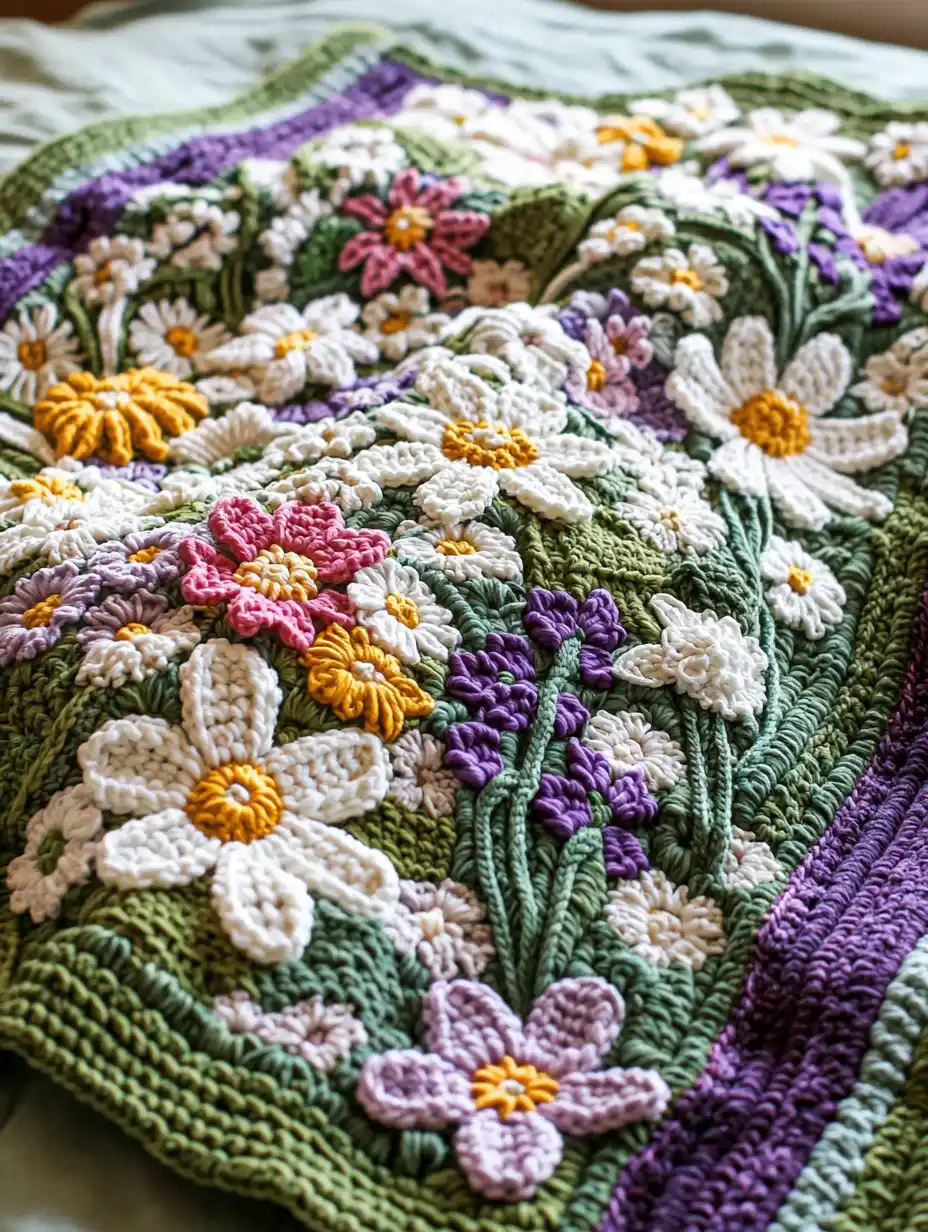
A blanket designed as a garden sampler, with sections of different flower types separated by narrow green border strips, each section planted with a different species in a formal garden bed arrangement. Roses in one section, lavender in another, sunflowers in a third, daisies in a fourth, the whole blanket reading as a garden plan viewed from above.
The cottage garden sampler blanket is the flower blanket that requires the most planning before the first stitch is made, because the garden plan determines the entire making sequence and the final reading of the blanket. Plan the garden before starting. Decide which flower sections adjoin which others, which border strips separate which beds, which colors appear in each section and in what proportion. A garden plan drawn on paper before the crochet begins is not a delay. It is the design process that determines whether the finished blanket reads as a garden or as a collection of unrelated flower sections placed adjacently. A garden is a planned thing. The sampler blanket rewards the planning that a garden requires.
Yarn: DK weight in species-accurate colors for four to six flower types, deep green for border strips
Hook: 4 mm
Flower count: 20 to 30 motifs per section across four to six sections
Making quality: The section structure divides a large blanket into manageable subsections, each with its own completion point. Finishing a garden section is a satisfying milestone
Room quality added: The cottage garden sampler blanket adds the pleasure of a planned garden to a room. It is the blanket for the person who reads seed catalogues in winter
13. Japanese Garden Blanket

A blanket in a restrained palette of deep indigo and soft cream and warm grey, with cherry blossom and chrysanthemum motifs arranged in the considered, sparse distribution of a Japanese garden aesthetic, the background negative space as important as the flowers placed within it. The Japanese garden blanket is the flower blanket that finds the beauty in what is not there as much as in what is.
The Japanese garden blanket requires a different quality of attention from most other flower blankets on this list because it asks the maker to resist the impulse to add more. The Japanese garden aesthetic places each flower at the position where the flower most enriches the space around it, which is rarely the position where the most flowers would fit. Planning the flower distribution for this blanket means placing each motif, stepping back, and asking whether this position serves the flower or crowds the space it should inhabit. The answer is not always the position with the most coverage. Often it is the position with the most surrounding space. Making this blanket slowly, with space between sessions to reconsider the placement of each completed motif before adding the next, produces a better blanket than making it quickly.
Yarn: DK weight in deep indigo for background, fine cotton in soft cream and pale blush for blossom motifs, warm grey for chrysanthemum
Hook: 4 mm for background, 2.5 mm for flower motifs
Flower count: 15 to 25 motifs in a considered sparse distribution
Making quality: This blanket rewards the maker who is comfortable working slowly and reconsidering placement decisions between sessions
Room quality added: The Japanese garden blanket adds a quality of deliberate calm to a room. It is the blanket for the room that is intended to be a place of quiet
14. Botanical Illustration Blanket
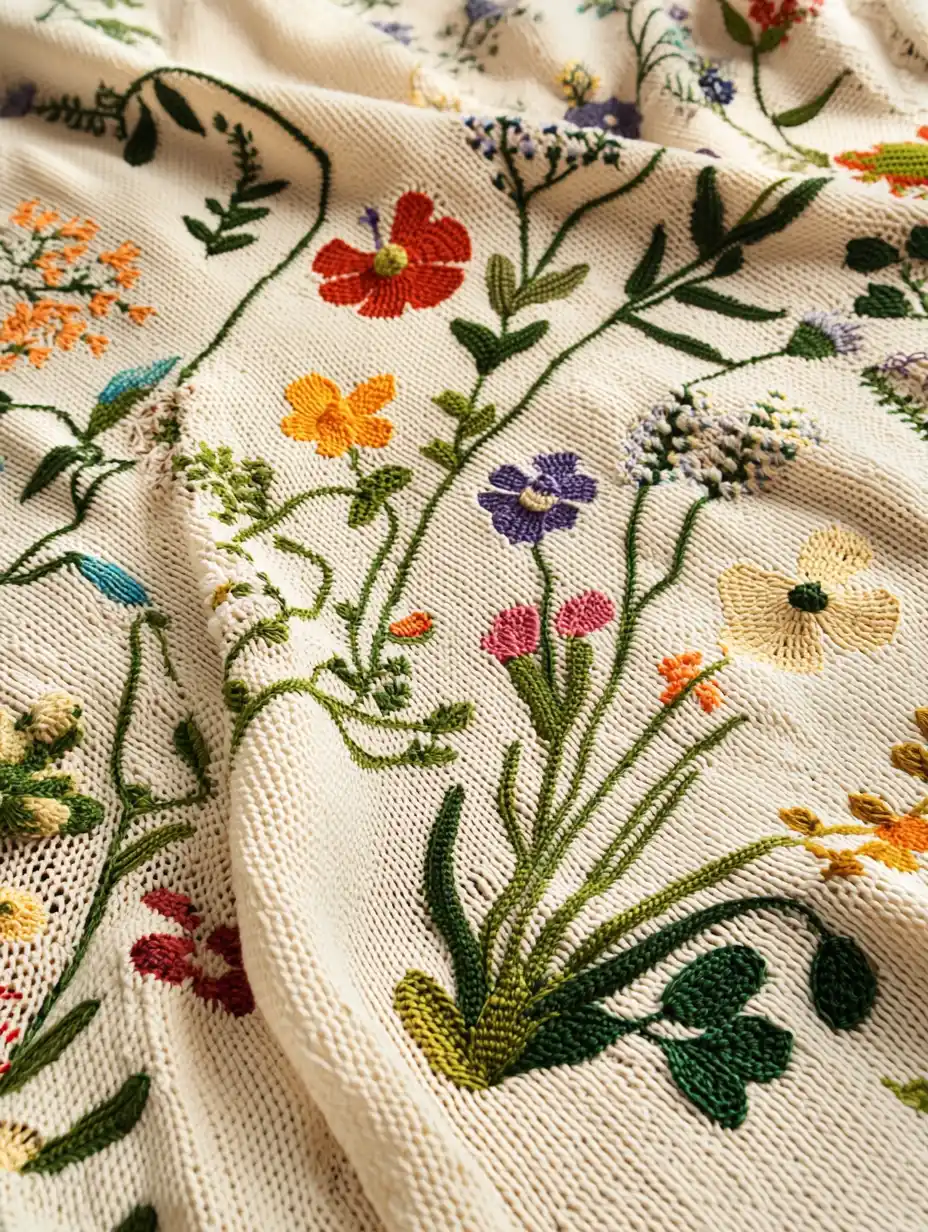
A blanket worked to evoke the format of a vintage botanical illustration plate, with each flower motif accompanied by its stem, leaves, and in some cases its root system or seed head, worked in the accurate colors and proportions of a scientific botanical illustration. The botanical illustration blanket is the most intellectually engaged of all the flower blankets on this list.
The botanical illustration blanket asks the maker to pay a specific quality of attention to the natural world: not the impressionistic attention of noticing that a flower is beautiful, but the observational attention of noticing what specifically makes it itself. The shape of its petals. The color of its center. The way its leaves attach to the stem. The way its root system branches. A maker who produces this blanket has spent the making time in close company with the plants they have chosen to represent and has learned something specific about each one. The blanket is the record of that learning. It reads differently to the viewer who can identify the species from the motifs and the viewer who cannot, and both readings are valid, but the first reading sees what the maker was paying attention to.
Yarn: DK weight in species-accurate colors for four to six different plant species complete with stems and leaves
Hook: 4 mm for background, 2.5 to 3.5 mm for detailed botanical motifs
Flower count: 6 to 10 complete botanical plant motifs with full stems and leaves
Making quality: Each complete plant motif requires multiple sessions and produces the deepest per-motif engagement of any blanket on this list
Room quality added: The botanical illustration blanket adds the specific beauty of a page from a great natural history book to a room. It is the blanket for the person who believes that accurate observation of the natural world is an act of respect toward it
15. Meadow at Dusk Blanket

A blanket worked in the palette of a meadow at the end of a summer day, the background in a deep warm navy and the flower motifs in the colors that remain visible in low light, pale cream and soft white and warm gold and the vivid pinks that glow in evening light. The dusk blanket is the flower blanket for the bedroom, for the time of day when the garden outside the window is settling into its evening colors.
There is a quality of light in a meadow at dusk that is different from any other quality of light in the day. The warm colors, the pinks and golds, continue to glow after the cool colors, the blues and greens, have receded into shadow. The meadow at dusk blanket holds this specific optical phenomenon in its color choices: the pale cream and warm gold flower motifs against the deep navy background reproduce the specific visual experience of standing in a meadow in the last light of an August evening when the pale flowers catch what remains of the light and seem to produce their own illumination. This is a blanket that reads differently in the morning and in the evening, and the evening reading is the one it was made for.
Yarn: DK weight in deep warm navy for background, fine cotton in pale cream, soft white, warm gold, and vivid pink for flower motifs
Hook: 4 mm for background, 2.5 mm for motifs
Flower count: 40 to 60 flower motifs in the dusk palette
Making quality: The deep navy background requires careful attention during joining to ensure the motif positions are correct, as the dark ground makes positioning errors less visible during construction
Room quality added: The meadow at dusk blanket adds the specific quality of a summer evening to a bedroom. It is the blanket that makes the room feel like the last hour of a good day
16. Climbing Rose Blanket

A blanket with a climbing rose design, worked as a continuous rose vine from one corner of the blanket, the vine constructed as a thick twisted cord from which rose motifs and leaf clusters emerge at irregular intervals, the vine traveling diagonally across the blanket surface as if climbing a wall. The climbing rose blanket is the most narrative of all the flower blankets on this list.
A climbing rose on a wall is one of the most specific and most evocative domestic images in the entire cottagecore visual vocabulary, and the climbing rose blanket translates that image into a blanket with complete fidelity. The vine travels from one corner across the blanket surface, not in a straight line but in the gentle diagonal curves of a real climbing rose stem that has been trained along a wall and has partly followed the training and partly followed its own inclination. The roses emerge from the vine at the angles at which roses grow from a climbing stem, slightly facing outward and upward, not perpendicular to the vine. The leaf clusters at each rose base are worked slightly larger than the rose they frame, because on a climbing rose the leaves are large and the roses emerge from among them rather than sitting in front of them.
Yarn: DK weight in a neutral background color, DK in rose colors and vine-green for the climbing design
Hook: 4 mm
Flower count: 12 to 18 rose motifs along the vine with leaf clusters between each
Making quality: The vine structure means the design grows continuously rather than in discrete motif units. Each session adds to a single connected element
Room quality added: The climbing rose blanket adds the specific narrative quality of a rose that is going somewhere to a room. It is the blanket that rewards looking at from different positions
17. Four Seasons Garden Blanket

A large blanket divided into four equal sections, each section representing a different season of the garden through its flower species and color palette: early blossom and pale green for spring, vivid daisy and sunflower and poppy for summer, late rose and russet leaf for autumn, bare branch and snowdrop for winter. The four seasons garden blanket is the most ambitious design on this list.
The four seasons garden blanket is made across a full year, ideally with each seasonal section made during the season it represents, the spring section in March and April, the summer section in June and July, the autumn section in September and October, the winter section in December and January. Made this way, the blanket is not only a design but a record of a year of making, each section carrying the light and the weather and the maker’s attention during the season in which it was produced. This is not a requirement. The blanket can be made in any sequence in any time of year. But there is a quality to a blanket made in the season it depicts that no other making method produces, and it is worth considering.
Yarn: DK weight in four seasonal palettes, each requiring four to six colors appropriate to its season
Hook: 4 mm
Flower count: 25 to 35 motifs per seasonal section, 100 to 140 total
Making quality: The section structure divides what would otherwise be an overwhelming project into four manageable and emotionally distinct phases
Room quality added: The four seasons garden blanket adds the full arc of a garden year to a room. It is the blanket for the person who pays attention to every season in the garden, not just the summer one
18. Secret Garden Blanket
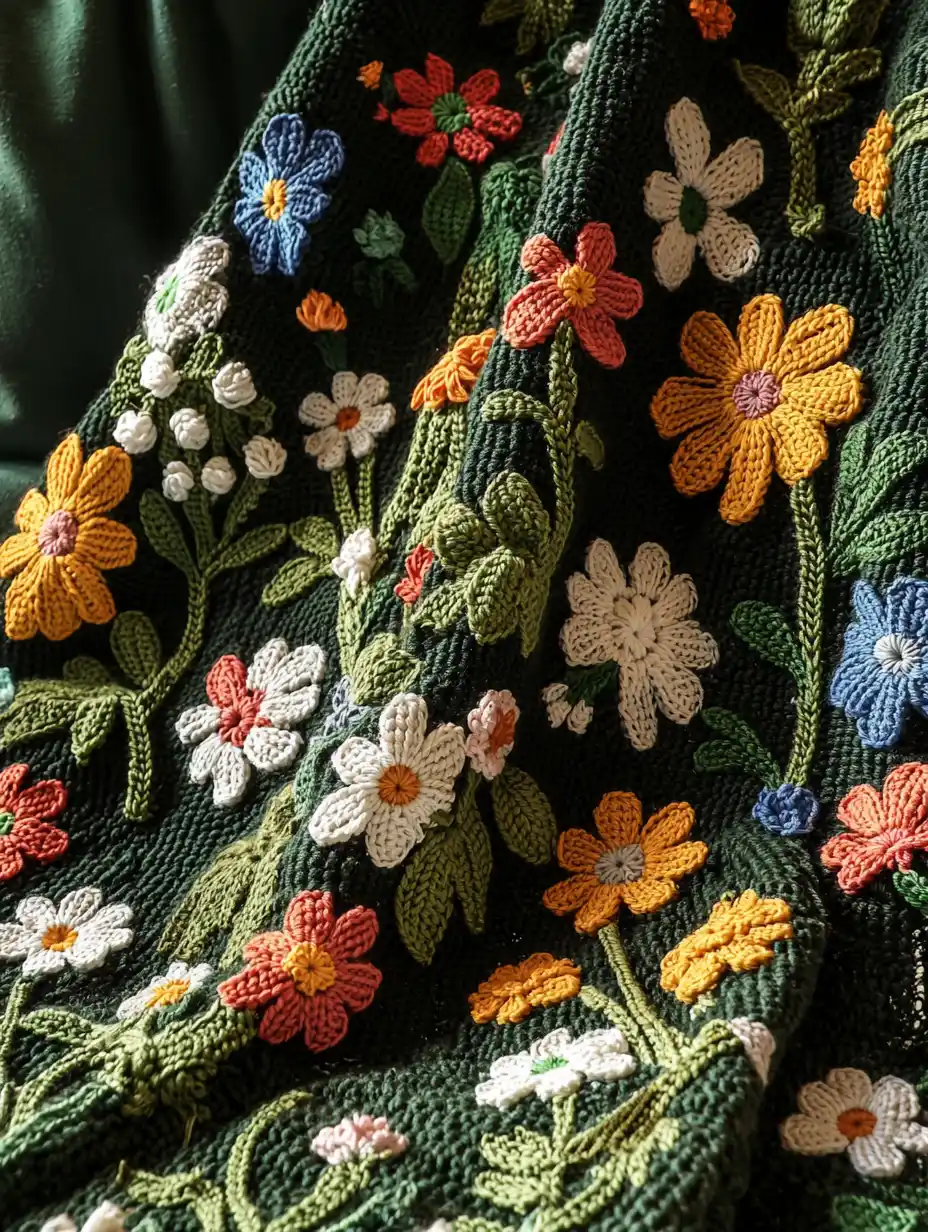
A large blanket worked in a deep background of forest green with flower motifs in vivid colors emerging from the green ground in the irregular abundance of an overgrown garden that has not been tended for a long time but has continued to flower regardless. The secret garden blanket is the flower blanket for the specific quality of a garden that belongs to itself rather than to its gardener.
A secret garden is a garden that has been left to its own inclinations. The flowers are there because they want to be there, not because they were planted in the position they now occupy. The secret garden blanket is worked accordingly: the flower motifs are distributed across the deep green background in positions that suggest self-seeding rather than planting, the flower density higher in some areas and lower in others, some flowers overlapping their neighbors slightly, some isolated in a section of pure green ground. There are no formal rows. There are no equal spacings. There is only the specific abundance of a garden that has been growing without intervention for long enough that it has become more itself than any garden plan intended, and is more beautiful for it.
Yarn: DK weight in deep forest green for background, DK in vivid flower colors for multiple species motifs
Hook: 4 mm
Flower count: 80 to 100 motifs of mixed species in a deliberately irregular distribution
Making quality: The deliberate irregularity of the distribution is the most meditative aspect of this blanket. Each motif position is a small decision made in the moment rather than planned in advance
Room quality added: The secret garden blanket adds a quality of natural abundance and freedom to a room. It is the blanket that makes a room feel like something is growing in it
Making a Flower Blanket Last
The Pace That Sustains a Long Project
A flower blanket is a long project. The maker who begins it planning to finish it quickly will not finish it well, and may not finish it at all. The pace that sustains a flower blanket across its full making time is the pace of one or two flowers per session, each session its own complete small event rather than a step toward the eventual finished object. A maker who makes one daisy per evening for sixty evenings has made a blanket. A maker who planned to make sixty daisies in a week has, in all likelihood, not made a blanket at all. The sustainable pace is the slow one. The blanket does not care how long it takes. It only cares that it is finished.
Color Planning Before the First Flower
The color arrangement of a flower blanket determines its reading from across the room, and the color arrangement cannot be corrected after the flowers are joined. Plan the color distribution before the first flower is made. Lay out yarn balls on a flat surface in the arrangement they will occupy in the finished blanket and look at it from across the room. The arrangement that reads clearly from three meters away is the correct arrangement. The arrangement that requires close examination to understand will also require close examination in the finished blanket, which is rarely the intended effect. The flower blanket that reads as a garden from across the room is the one whose color distribution was planned before a single stitch was made.
Joining Methods for Flower Blankets
The joining method determines the reading of the blanket’s surface as much as the flower motifs themselves do. A flat invisible join in a matching background color produces a blanket whose flowers appear to grow from a continuous ground with no visible grid between them. A raised join in a contrasting color produces a blanket with a visible grid that frames each flower like a tile in a mosaic. A join-as-you-go method, worked during each flower’s final round, eliminates the separate joining session and maintains the making momentum of completing each flower fully before moving to the next. Choose the joining method based on the intended reading of the finished blanket, not based on which method is most familiar. Different joining methods produce fundamentally different blankets from the same flower motifs. The join is a design decision, not an administrative step.
Frequently Asked Questions
How many flowers does a crochet flower blanket need?
The flower count for a throw-sized blanket varies with the motif size. Small flower motifs of five to eight centimeters require eighty to one hundred and twenty flowers to cover a standard throw of one hundred and thirty by one hundred and sixty centimeters. Medium motifs of ten to twelve centimeters require forty to sixty flowers. Large motifs of fifteen centimeters or more require twenty to thirty flowers. These are approximate counts because the exact number depends on the specific motif’s outer dimensions, the joining method, and whether background filler squares are used between motifs. The most accurate way to calculate the flower count for any specific blanket is to make one flower, block it, measure its blocked dimensions, and calculate how many fit in the intended finished dimensions. This takes twenty minutes and eliminates any uncertainty about the final flower count before the full making commitment is made.
What yarn is best for a crochet flower blanket?
A smooth DK weight in a natural fiber or a quality superwash blend produces the best flower blanket results because it blocks well, holds the flower motif’s shape after blocking, and produces clear stitch definition that makes the flower forms readable. Cotton DK produces the crispest stitch definition and the most washable finished blanket. Merino or superwash wool DK produces a softer finished blanket with more drape. A cotton-acrylic blend produces a blanket that is fully machine washable and colorfast. For the fine detail flower motifs in the botanical illustration and the spring blossom blankets, a fingering weight or fine cotton thread produces the scale that the motif’s detail requires. The yarn choice is the first decision that determines the blanket’s character. Make it thoughtfully.
How do I stop losing motivation halfway through a flower blanket?
The halfway point of any large project is the point at which the end is still as far away as the beginning and the novelty has worn off. For a flower blanket, the halfway point is the point at which the maker has made enough flowers to have fully internalized the motif pattern but not yet enough to see the final reading of the assembled blanket. Three practices sustain motivation through the halfway point. The first is to lay out the completed flowers in their intended arrangement regularly, every ten to fifteen flowers, so the emerging picture is visible rather than imaginary. The second is to change the color or the species being made at the halfway point, even briefly, to reintroduce variety into the making. The third is to count the flowers made and subtract from the total needed rather than counting up from zero, because seeing the count decrease toward completion is a different psychological experience from watching it increase toward a distant total.
Do crochet flower blankets need to be blocked?
Yes. A flower blanket in an unblocked state does not show its full design because the individual motifs are slightly distorted by the tension of the joining and the natural curl of the crochet fabric. Blocking flattens every motif to its correct dimensions, opens the petal shapes to their full intended form, and produces the flat, even blanket surface that the design requires to read correctly from across the room. Wet blocking for a cotton or wool blanket and spray blocking for more structured blankets are both effective. Pin every motif at its outer edges to a flat surface and allow to dry completely before removing. The blocking process for a large flower blanket takes several hours of pinning and twenty-four hours of drying. It is the final session that converts a finished crochet object into a finished blanket. It is worth doing fully.