A crochet plant occupies a room differently from a living plant. It does not require water or light or the specific anxiety of watching a leaf yellow and wondering what you did wrong. What it requires is the making, which is its own form of attention, and then the placing, which is its own form of care. A handmade plant in a room is a record of the hours spent making it, which are also hours of quiet and focus and the specific satisfaction of a needle moving through yarn in a pattern that produces, gradually and then all at once, something that looks like it grew. These fifteen crochet plant patterns range from the smallest succulent to the largest monstera, each with its own specific quality of presence in a room and its own specific relationship with the light and the surfaces around it. Make one. Place it somewhere it can be seen. Notice what changes.
This list covers 15 crochet plant patterns for indoor display, each with specific notes on the plant’s room quality, the colors and materials that produce the most realistic reading, and the display context that allows each plant to contribute most fully to the feeling of a home.
1. Crochet Monstera Leaf
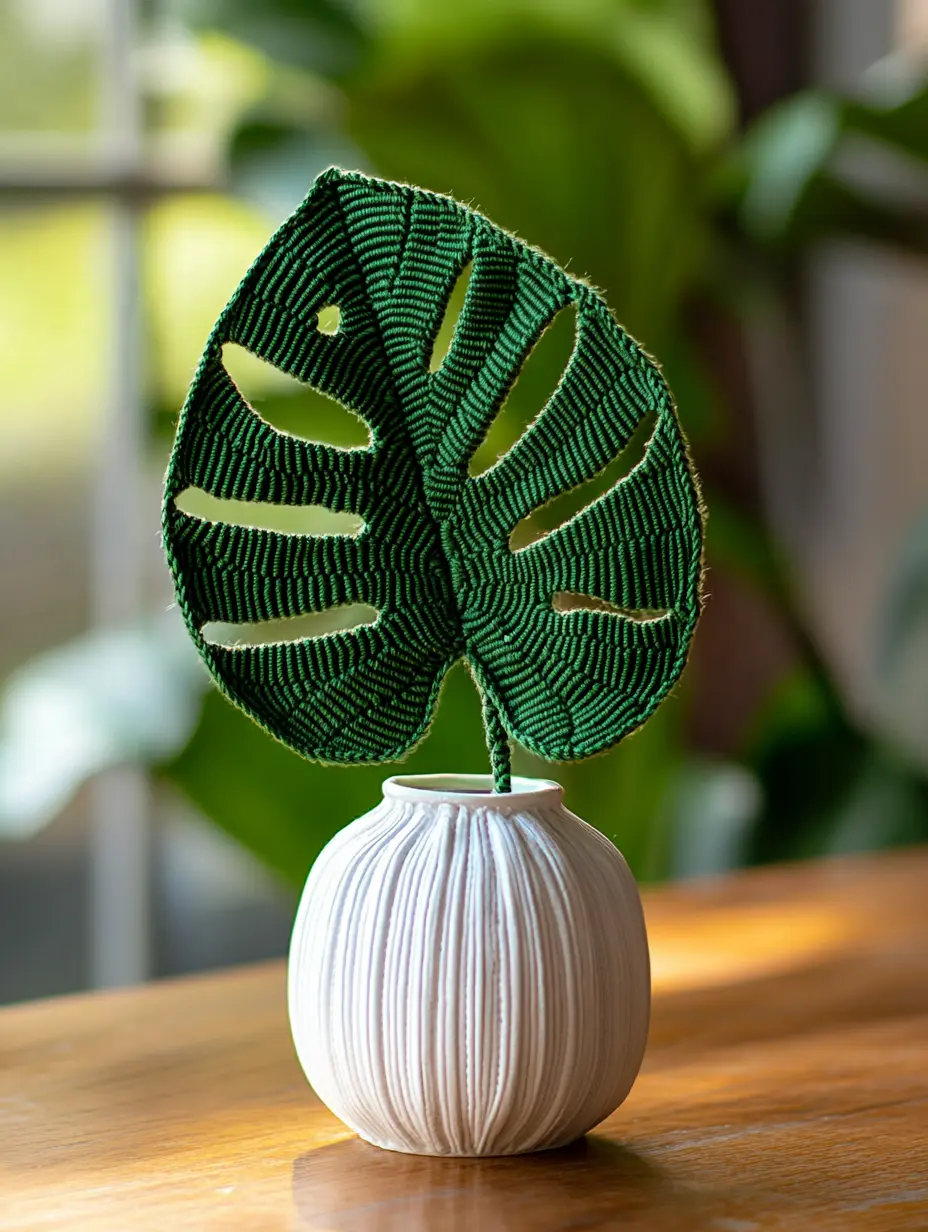
A large flat monstera leaf worked in a deep tropical green with the characteristic split and hole fenestrations cut into the leaf surface by leaving chain spaces at the fenestration positions during construction. The monstera is the houseplant most associated with the specific interior aesthetic of a home that takes plants seriously, and the crochet version carries the same visual authority as the living plant at a fraction of the maintenance.
In a deep tropical green fine cotton with the fenestration holes left open as chain spaces during the leaf’s construction the crochet monstera leaf reads as the specific leaf that interior photographers place beside every object they are trying to make look considered and intentional. The fenestrations are the detail that makes or breaks the monstera reading: a large green leaf without holes is a large green leaf. A large green leaf with the correct irregular oval holes is a monstera. Work each fenestration as a chain space in the correct position within the leaf’s row structure, leaving the chain unworked in subsequent rows to maintain the open hole. Block the completed leaf flat and stiffened with fabric stiffener before placing upright in a narrow vase or leaning against a wall. A monstera leaf that droops or curls reads as an unfinished object. A monstera leaf that holds its shape reads as a considered decorative object.
Yarn: Fine cotton or DK cotton in deep tropical green
Hook: 2.5 to 3.5 mm
Stiffening: Fabric stiffener applied after blocking, pinned flat until dry
Display: Upright in a narrow ceramic vase or leaning against a white wall
Room quality added: The tropical leaf brings the specific quality of a room where growth is taken seriously to any surface it occupies, regardless of whether any living plant is present
2. Potted Succulent Collection
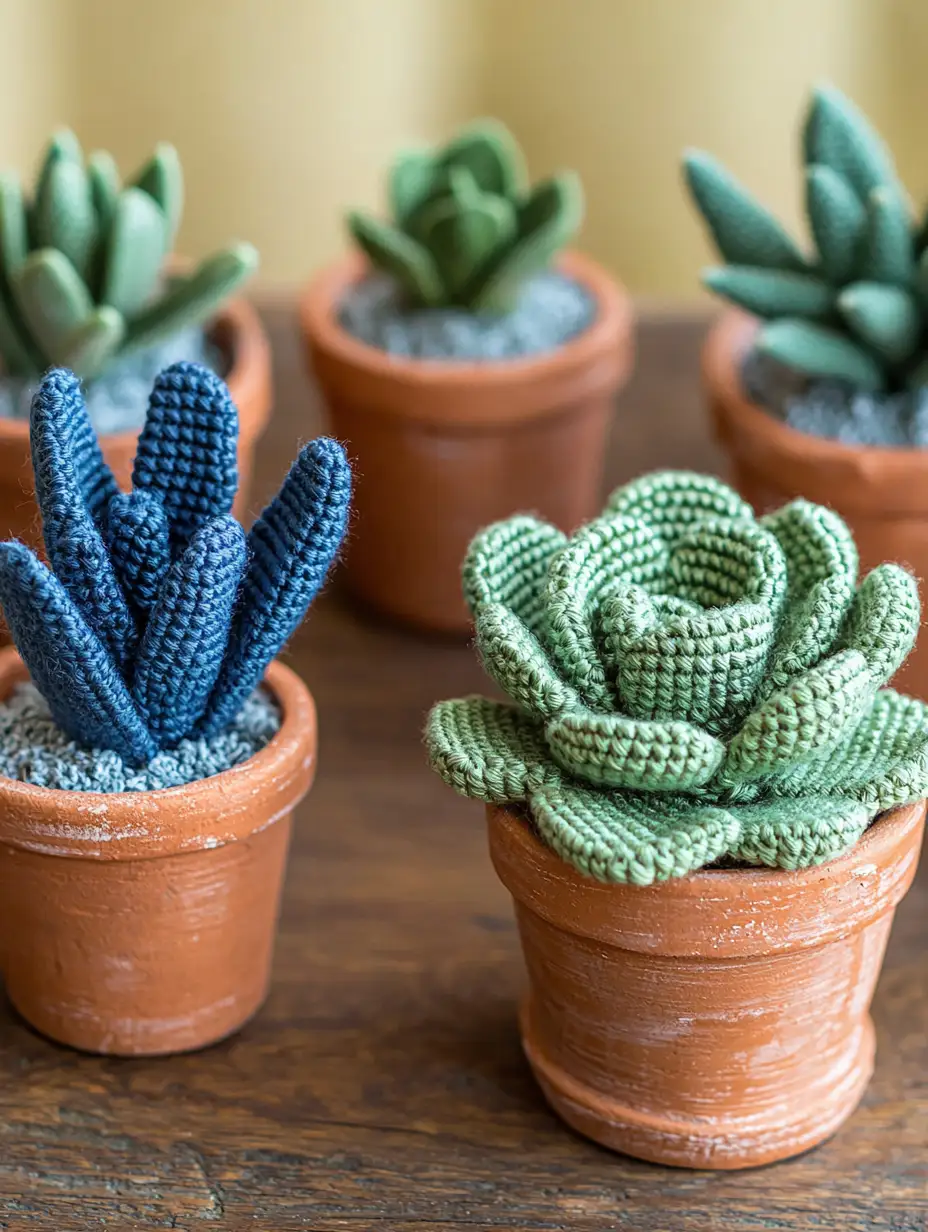
A collection of three to five small succulent forms worked in different shapes, a rosette form, a tall columnar form, a spreading multi-armed form, each in a slightly different succulent green, placed in small terracotta or ceramic pots filled with sand or fine gravel for stability. No two succulents in the collection are the same species or the same shade of green.
In a range of blue-green and warm green and grey-green and dusty sage small succulent forms worked with tight tension to produce firm, self-supporting shapes the potted succulent collection reads as the most universally loved arrangement on this list because succulents have achieved a specific cultural status as the plant for people who want the presence of plants in their homes without the complexity of their care requirements. The crochet version is faithful to this quality: it is present, it is green, it occupies a surface with the specific compactness and geometric perfection of a real succulent, and it requires nothing. Place the collection on a windowsill, a bathroom shelf, or a kitchen counter. The grouping of three to five different forms reads as more considered than a single succulent and requires less space than a larger plant arrangement.
Yarn: Fingering weight in three to five succulent greens with slight blue or grey undertones
Hook: 2.25 mm
Stuffing: Polyester fiberfill or dried rice for weight and stability
Pots: Small terracotta or ceramic pots filled with sand or fine gravel
Room quality added: The succulent collection brings the specific stillness of a windowsill garden to any surface, the sense that someone here tends small things with attention
3. Trailing Pothos Plant
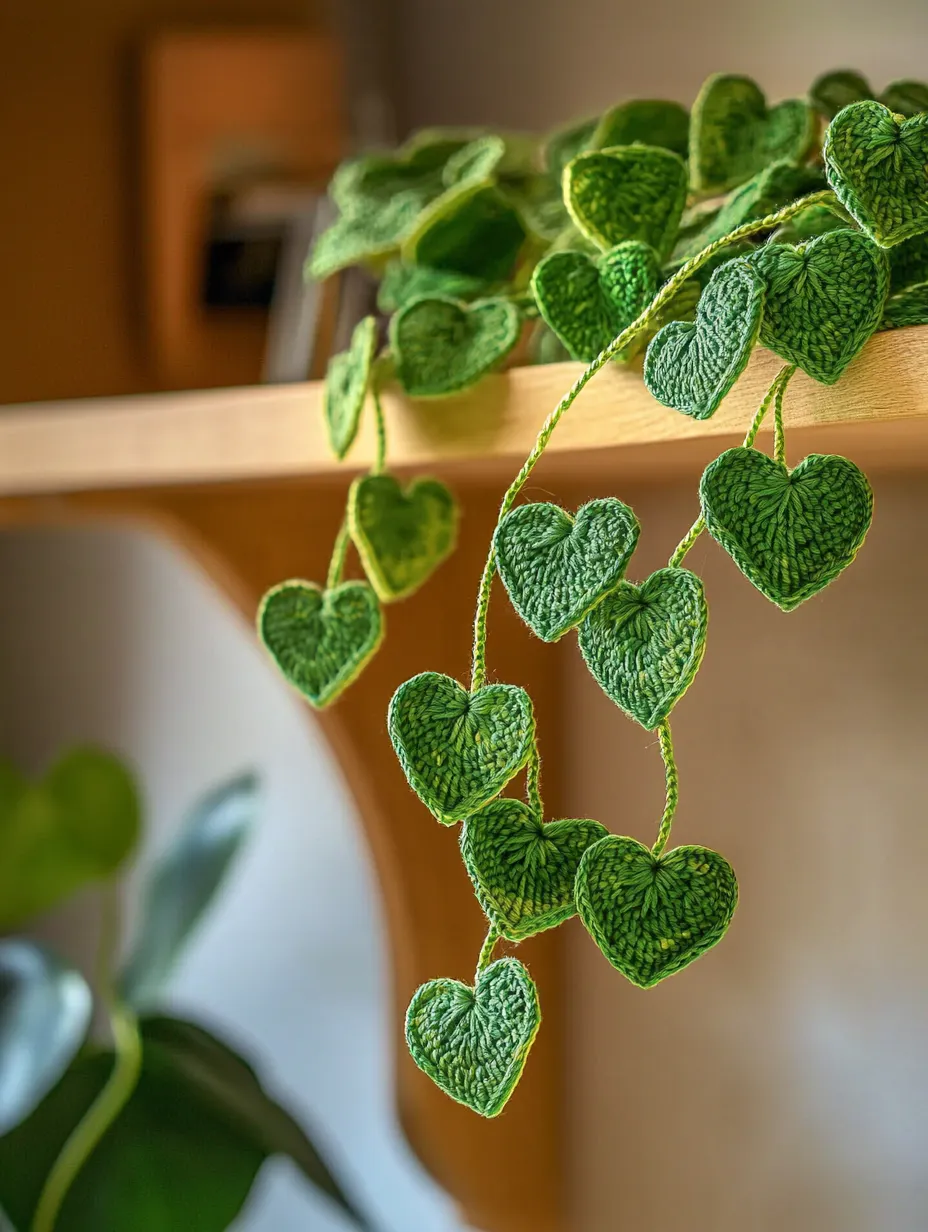
A pothos plant worked as a continuous vine of heart-shaped leaves on a thin green wire stem that can be shaped and draped over a shelf edge or wound around a bookcase corner, the trailing quality of the vine being the specific visual element that the pothos contributes to every surface it occupies. Twelve to twenty leaves per vine, each leaf in a slightly different position on the wire stem.
In a vivid medium green with occasional leaves in a slightly more yellow-green to replicate the natural color variation of a real pothos the trailing pothos plant reads as the plant that most completely changes the character of a bookcase or a shelf because it introduces the trailing, downward movement that no upright object on a shelf can produce. The wire stem inside the vine allows the maker to arrange the trail exactly as desired, looping one section over the shelf edge and directing another section along the shelf surface, with individual leaves positioned to catch the light at angles that the fixed flat surface of a shelf would otherwise not produce. The pothos is the trailing plant that requires the least botanical specificity to read as itself: a heart-shaped leaf on a trailing vine is immediately understood as a pothos by anyone who has ever owned one.
Yarn: DK weight in vivid medium green and yellow-green
Hook: 3.5 mm
Armature: Fine green-coated floral wire threaded through each leaf and the main vine stem
Display: Draped over a shelf edge, wound around a bookcase, or placed in a hanging planter
Room quality added: The trailing pothos introduces downward movement and organic line to any horizontal surface, which is the specific visual quality that living trailing plants bring to shelves and which no upright object replicates
4. Cactus in a Terracotta Pot

A tall columnar cactus or a rounded barrel cactus worked in a firm green cotton with surface texture added through strategically placed surface slip stitches that read as the cactus’s characteristic ribs, placed in a small terracotta pot with yarn spines of cream or pale yellow attached at intervals. The cactus is the plant that reads as the most independent, the one that asks least and gives most in terms of the specific quiet it brings to a desk or a windowsill.
In a warm medium green for the cactus body with cream yarn spine clusters and a warm terracotta small pot the crochet cactus reads as the specific domestic presence of a cactus on a sunny windowsill that has been there for years and has never needed anything. The surface rib texture, worked as surface slip stitches running vertically from base to tip along the cactus body, is the construction detail that most produces the cactus reading rather than the generic rounded plant reading. A smooth green cylinder is not a cactus. A green cylinder with vertical surface ribs and cream spine clusters is. The spine clusters are attached after the cactus body is complete, each cluster of three to five short lengths of cream yarn knotted through the fabric surface at the rib intersection positions.
Yarn: DK weight firm cotton in warm medium green, cream for spines
Hook: 3.5 mm
Stuffing: Polyester fiberfill plus a cardboard tube insert for columnar stability
Pots: A small terracotta pot in an appropriate size for the cactus diameter
Room quality added: The cactus brings the specific quality of patient endurance and sun-oriented stillness to any desk or windowsill it occupies
5. Fiddle Leaf Fig Tree

A tall fiddle leaf fig worked with a wire-supported trunk and four to six large fiddle-shaped leaves branching from the upper trunk, each leaf in a deep rich green with visible veining embroidered after the leaf is complete. The fiddle leaf fig is the large statement plant, the one that occupies a floor corner and reads from across the room as the room’s primary vertical element.
In a deep rich green with warm yellow-green veining embroidered across each large leaf and a warm brown wrapped wire trunk the fiddle leaf fig reads as the large houseplant whose presence in a room most completely transforms the experience of the room’s corner, because the corner of a room without a plant is a corner, and the corner with a tall plant is the room’s most alive point. The veining on each leaf is the detail that elevates the fiddle leaf fig from a large green leaf shape to a specific botanical object: the central vein running from stem to tip and the branching lateral veins worked in a slightly lighter yellow-green produce the characteristic map of a real fiddle leaf fig leaf. Stitch the veining with a tapestry needle after the leaf is complete and blocked.
Yarn: DK weight in deep rich green for leaves, warm brown for trunk
Hook: 4 mm
Armature: Thick gauge wire wrapped in brown yarn for trunk, fine wire inside each leaf
Display: A floor-standing wicker basket or a ceramic floor pot
Room quality added: The fiddle leaf fig transforms the room’s corner from empty to inhabited, adding the specific vertical presence and organic silhouette that no furniture or artwork provides
6. Lavender Bundle
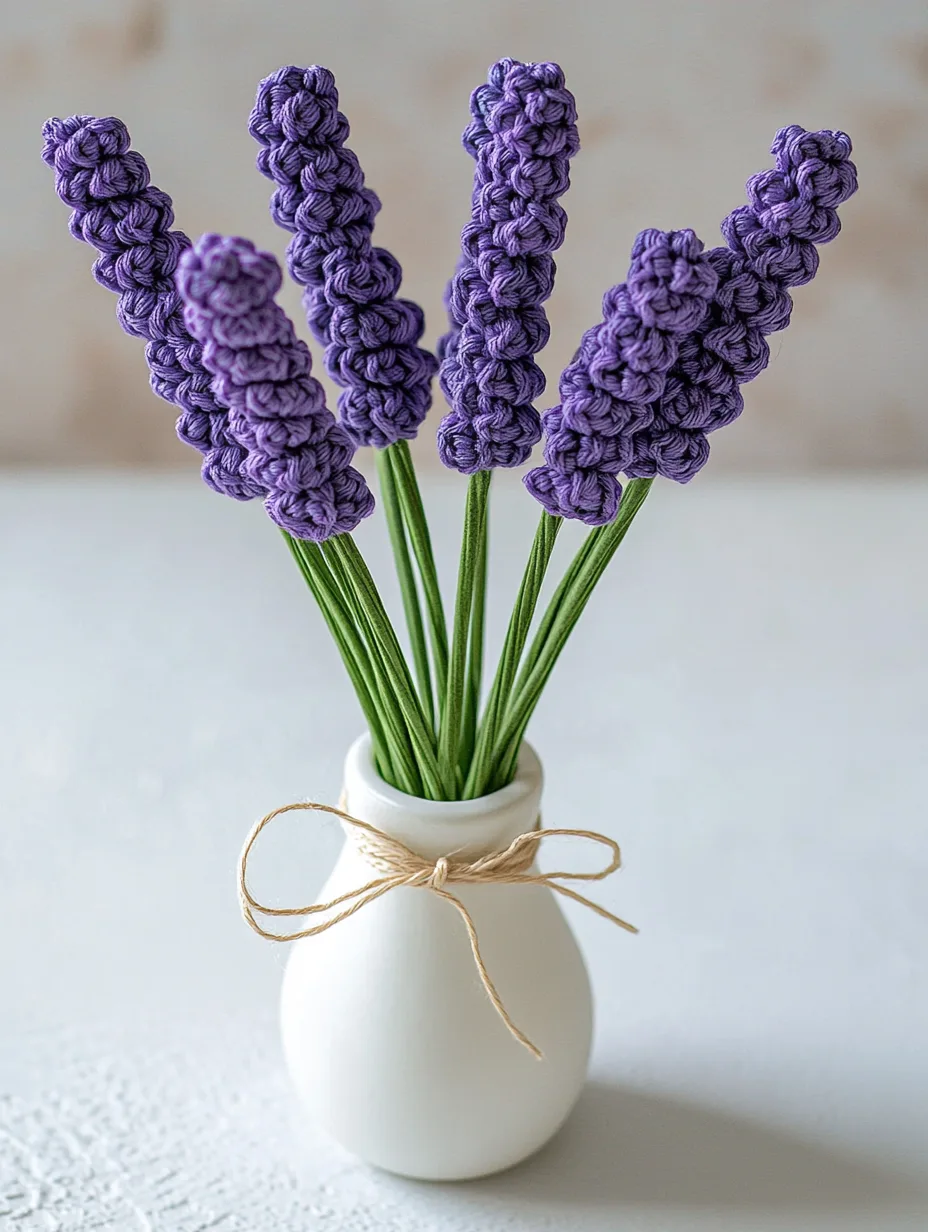
A bundle of ten to fifteen lavender stems, each worked as a thin green wire stem with small deep purple loop stitches suggesting the florets along the upper third, tied together at the base with a length of natural twine and placed in a small ceramic vase or a small glass jar. The lavender bundle is the most scent-associated plant on this list, which means it carries the memory of scent even when no scent is present.
In the specific deep Provencal purple of real lavender florets on bright green stems tied with natural undyed cotton twine the lavender bundle reads as the handmade version of the dried lavender bundles sold at farm shops and flower markets in late July when the Provencal fields are at their most vivid. The loop stitch florets along each stem upper half must be worked densely enough that the stem reads as covered in florets rather than as a green stem with a few purple loops along it. Twelve to fifteen loop stitches along the upper third of each stem is the minimum for the full lavender reading. Place the bundle in a small white ceramic vase on a bathroom shelf or a kitchen windowsill. The lavender bundle is the plant that most completely changes the domestic quality of a small room.
Yarn: Fingering weight in deep Provencal purple for florets, bright green for stems
Hook: 2.25 mm
Armature: Fine green floral wire inside each stem
Display: Tied with natural twine and placed in a small white ceramic vase
Room quality added: The lavender bundle brings the specific quality of a room that has been tended with botanical care to any bathroom shelf or kitchen windowsill it occupies
7. Snake Plant
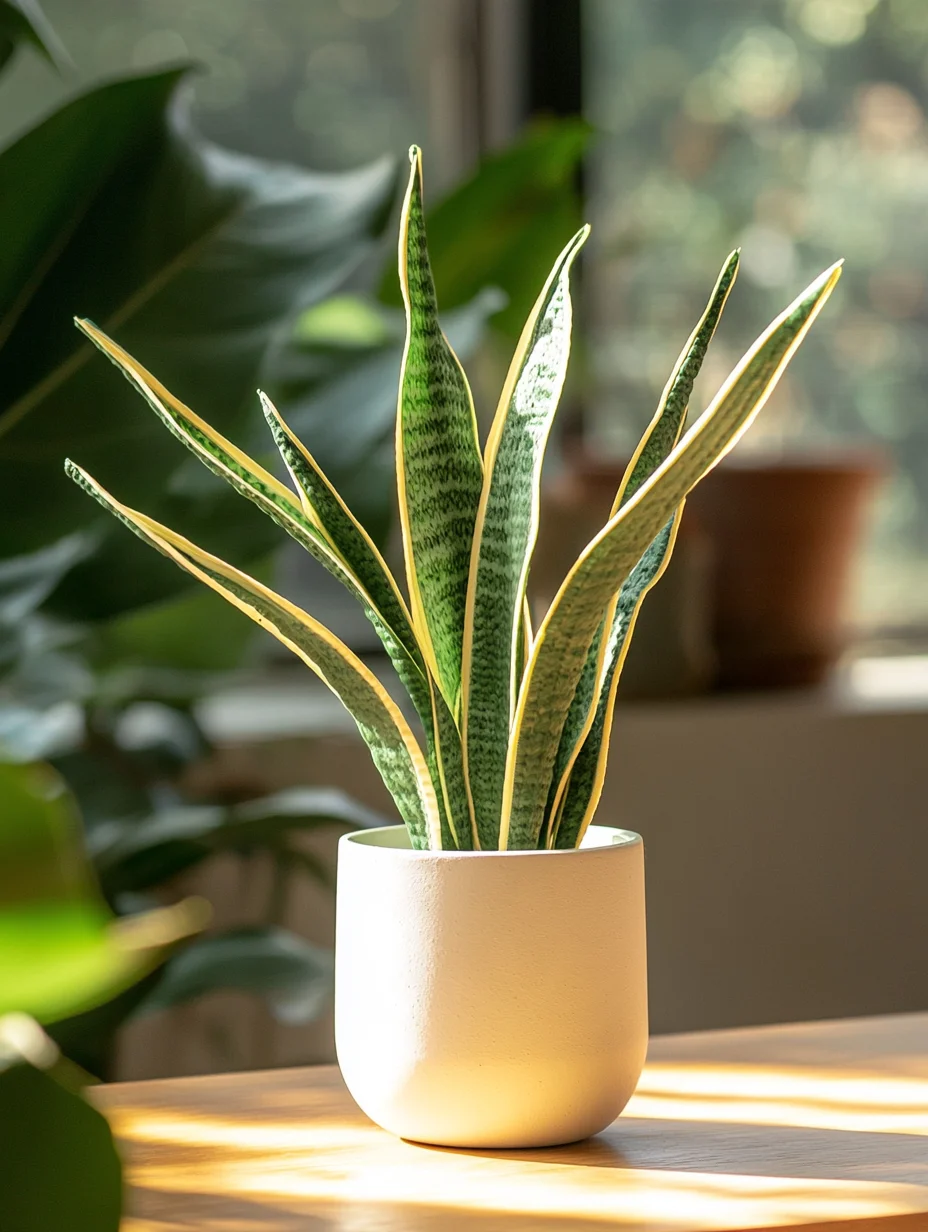
A snake plant worked with four to six tall upright sword-shaped leaves in a deep green with pale yellow-green margins and subtle horizontal banding, each leaf stiffened with an internal wire and placed upright in a cylindrical ceramic pot. The snake plant is the most architecturally formal plant on this list and the one that contributes the most specific vertical structure to a room.
In a deep green with pale yellow-green margins worked as a slip stitch color change along each leaf edge and subtle horizontal banding embroidered across the leaf face the snake plant reads as the specific plant that interior designers place in every room that needs vertical structure without the drama of a large leafy plant. The pale yellow-green margin along each leaf edge is the identifying detail of the snake plant and the one that distinguishes it from a generic upright leaf: work it as a two to three stitch wide strip of the paler color along both long edges of each leaf using a carried yarn technique so the margin appears as part of the leaf construction rather than as a surface addition. The horizontal banding, embroidered with a tapestry needle in a slightly lighter green across the leaf face at two to three centimeter intervals, completes the species reading.
Yarn: DK weight in deep green for leaf body, pale yellow-green for margins
Hook: 4 mm
Armature: Medium gauge wire inside each leaf for upright rigidity
Display: A tall cylindrical ceramic pot in white or charcoal
Room quality added: The snake plant brings formal vertical structure and the specific quality of architectural botanical presence to any floor corner or console table it occupies
8. Eucalyptus Stem Arrangement

A small arrangement of three to five eucalyptus stems, each worked as a thin wire stem with small rounded leaves in a dusty blue-green at intervals along the stem, displayed in a narrow ceramic vase or a small glass bottle. The eucalyptus stem is the most neutral and widely compatible plant arrangement on this list, the one that suits every room aesthetic from minimalist to maximalist without competing with anything around it.
In the specific dusty blue-green of real eucalyptus leaves, a color that reads as both grey and green simultaneously depending on the light, the eucalyptus stem arrangement reads as the plant equivalent of a neutral wardrobe basic: it makes everything around it look more considered without drawing attention to itself. Three stems at slightly different heights in a small ceramic vase is the arrangement that reads most naturally because real eucalyptus stems at slightly different lengths produce the same gentle variation in height that the eye expects of a gathered stem arrangement. The dusty blue-green color is the eucalyptus’s single most important quality and must be matched as closely as the yarn range allows. A vivid bright green is not eucalyptus. The specific grey-blue-green that the eye associates with dried botanical arrangements and Scandi interior styling is.
Yarn: Fingering weight in dusty blue-green
Hook: 2.25 mm
Armature: Fine green floral wire inside each stem
Display: Three to five stems at different heights in a small narrow ceramic vase
Room quality added: The eucalyptus arrangement brings the specific neutral botanical calm that makes any surface feel curated without imposing a specific aesthetic on the surrounding objects
9. Aloe Vera Plant
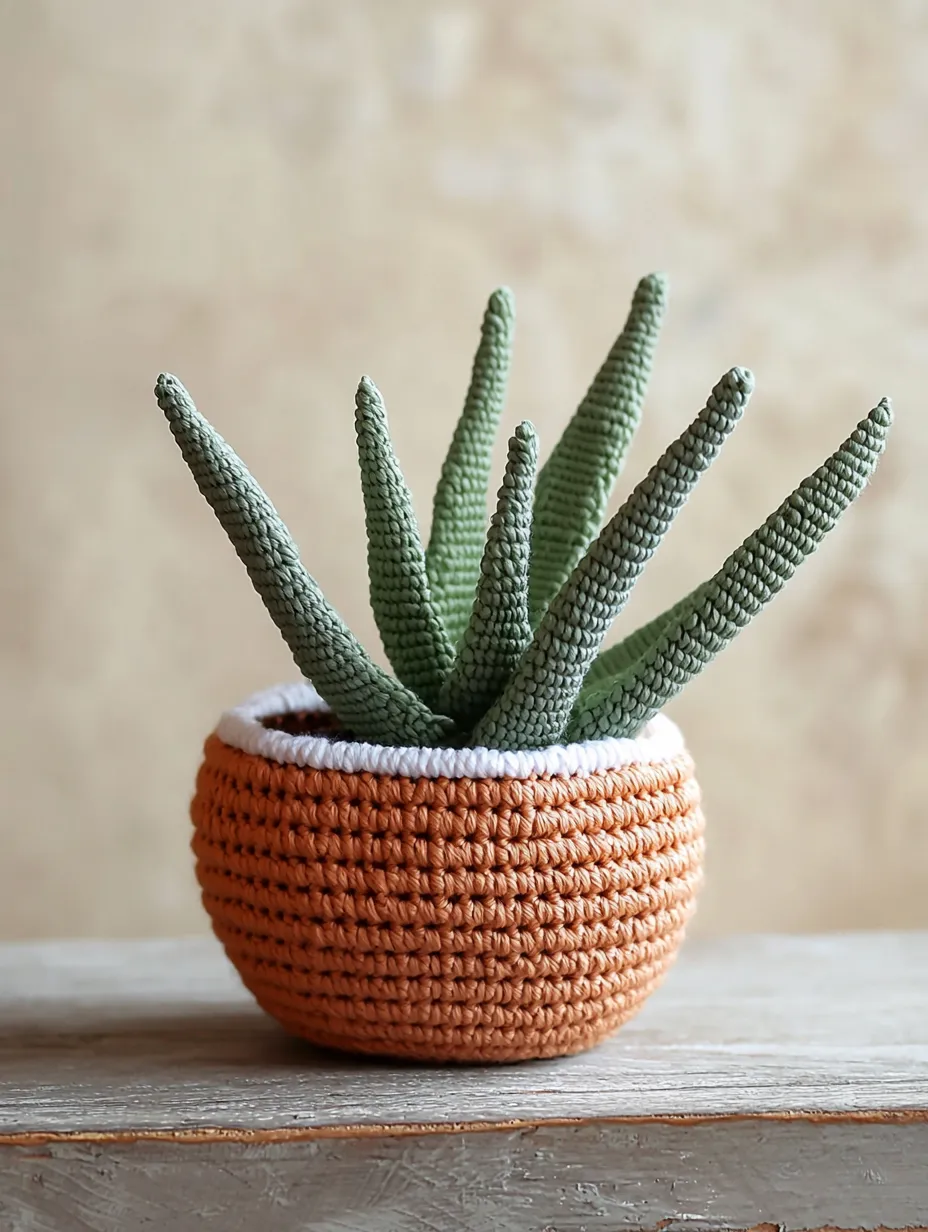
An aloe vera worked with six to eight thick fleshy-looking leaves radiating from a central base, each leaf in a pale grey-green with small white tooth details along the leaf edges, placed in a shallow terracotta bowl or a wide low pot. The aloe is the plant of the kitchen or the bathroom, the plant most associated with practical healing use and the specific domestic presence of a plant that is both beautiful and useful.
In a pale grey-green with small white chain stitch teeth along both leaf edges the aloe vera plant reads as the specific plant that has sat on the kitchen windowsill or the bathroom shelf of every household that has ever had one, which is a very large number of households. The fleshy quality of each aloe leaf is achieved by working the leaf in a slightly thicker yarn than the succulent collection and stuffing each leaf firmly before the tip is closed, producing the characteristic thick, rounded cross-section of a real aloe leaf. The white tooth details along each leaf edge, worked as small picot chain stitches after the leaf is complete, are the species-identifying detail. Without them, the plant reads as a generic spike plant. With them, it reads as an aloe.
Yarn: DK weight in pale grey-green, cream for tooth details
Hook: 4 mm
Stuffing: Firm polyester fiberfill for fleshy leaf thickness
Pots: A shallow terracotta bowl or a wide low ceramic pot
Room quality added: The aloe brings the specific domestic warmth of a useful plant, one that gives as well as occupies, to any kitchen or bathroom surface
10. Air Plant on Driftwood
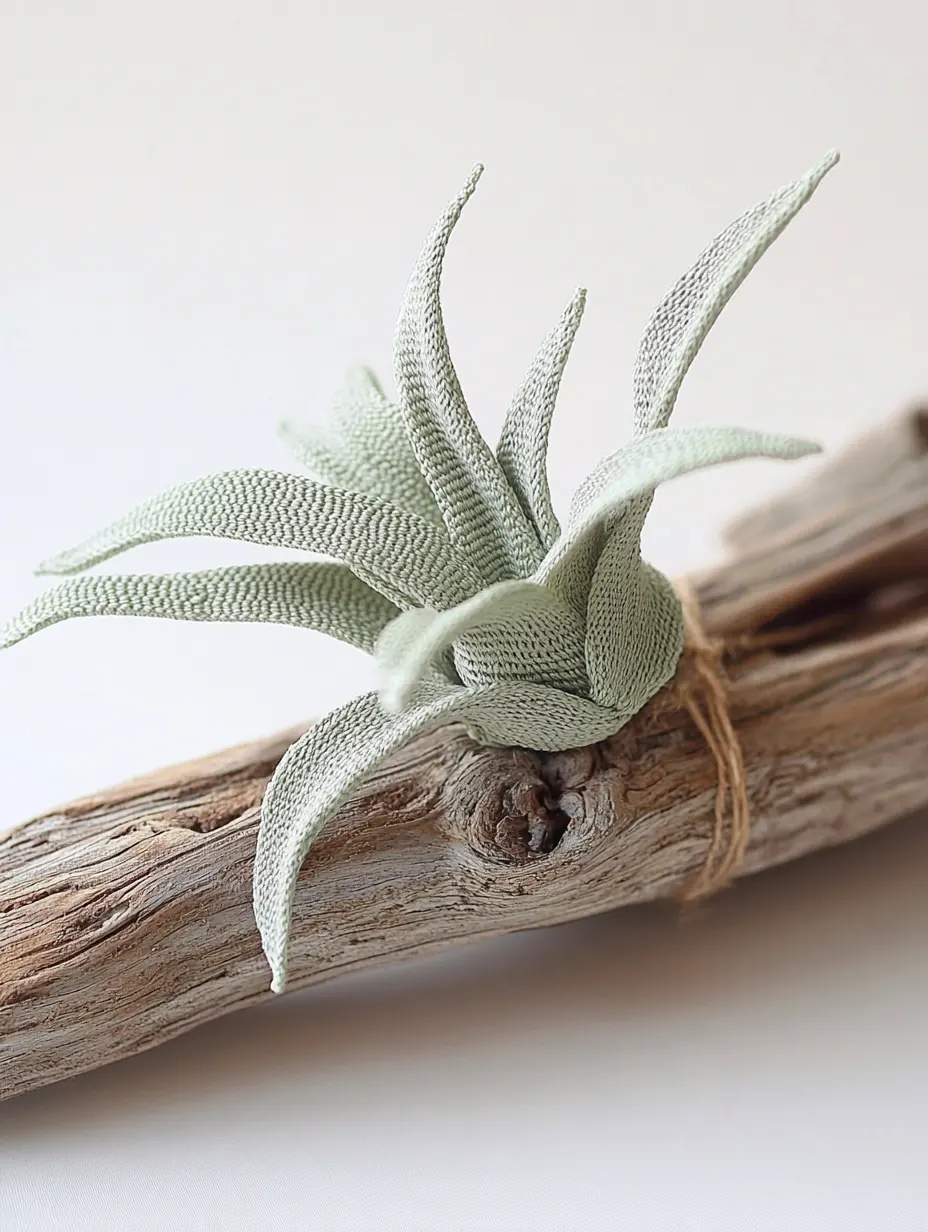
A small air plant tillandsia form worked as a cluster of thin curling leaves in a silvery pale green, attached to a piece of real driftwood with a small length of natural twine. The air plant on driftwood is the most minimal arrangement on this list and the one that most completely occupies its natural aesthetic context without requiring a pot, a surface, or any conventional plant display infrastructure.
In a silvery pale green with slight grey undertones, the specific color of a real tillandsia in its between-watering state, the air plant on driftwood reads as the arrangement that belongs in a home where the materials themselves, the pale grey driftwood, the silvery green yarn, the natural twine, are doing as much aesthetic work as the object they compose. The curling leaf forms are worked as thin tapered tubes of three to five rounds, each tube slightly curved by the wire inside it before attachment to the driftwood surface. A tillandsia with straight uncurled leaves reads as a yarn object. A tillandsia with gently curling leaves reads as a plant.
Yarn: Fingering weight in silvery pale green
Hook: 2.25 mm
Armature: Fine wire inside each leaf for curl positioning
Base: A piece of real driftwood or a rough-surfaced natural wood section
Room quality added: The air plant on driftwood brings the specific quality of natural materials in their least processed state to any surface, the stillness of the shore and the forest simultaneously
11. Hanging Macrame Planter with Succulent

A simple crochet hanging planter worked in a natural cotton rope with a small crochet succulent seated in the planter base, the planter suspended from a ceiling hook or a curtain rod bracket. The hanging planter introduces the vertical dimension to a plant arrangement and changes the experience of the room’s air by placing the plant at eye level or above rather than on a surface below the line of sight.
In a natural undyed cotton rope planter with a small vivid green rosette succulent seated in the base the hanging macrame planter with succulent reads as the plant arrangement that uses height as its primary design element rather than surface area. At eye level or slightly above, the hanging planter changes the experience of moving through a room by placing a green object at the height where the eye naturally travels rather than below it on a shelf or table. The planter itself, worked in a simple basket weave or open mesh pattern in natural cotton rope, should be sized to hold the succulent firmly without the succulent sitting too deep inside the planter basket and becoming invisible from below.
Yarn: Natural cotton rope 4 to 5 mm for planter, fingering weight for succulent
Hook: 7 mm for planter, 2.25 mm for succulent
Hardware: A ceiling hook or curtain rod bracket rated for the combined planter and plant weight
Display: Suspended at eye level in a well-lit corner or beside a window
Room quality added: The hanging planter brings the plant into the vertical plane of the room, placing living green at the height where the eye travels and where no surface-based plant can reach
12. Fern Frond Arrangement

An arrangement of three to five fern fronds, each worked as a central wire stem with small oval leaflets branching from the stem at intervals, displayed in a dark ceramic pot or a woven basket. The fern is the plant of shade and moisture, the plant most associated with the specific quality of a cool, still interior space that has good natural light without direct sun.
In a fresh medium green for the leaflets and a slightly darker green for the main stem the fern frond arrangement reads as the plant that belongs in the corner of a reading room or a study where the light is good but diffuse and where the presence of something growing quietly in the background changes the quality of concentration in the room. Each fern frond is worked with the leaflet pairs at slightly different sizes: largest near the middle of the frond and progressively smaller toward both the base and the tip, which is the pattern that real fern fronds follow and which produces the characteristic tapered silhouette of the fern that reads as botanically correct from across the room.
Yarn: DK weight in fresh medium green and slightly darker stem green
Hook: 3.5 mm
Armature: Medium gauge wire inside each frond stem for positioning
Display: A dark ceramic pot or a natural woven basket
Room quality added: The fern brings the specific quality of cool, diffuse-light stillness to any reading or study space, the botanical presence of shade-garden calm in a domestic interior
13. Cherry Blossom Branch

A cherry blossom branch worked as a thick twisted wire trunk with thinner branching wire stems, each stem bearing three to five small five-petal blossom forms in soft blush pink and pale cream with small yellow stamen clusters, displayed in a tall narrow vase or propped in a corner with the branching structure visible. The blossom branch is the most seasonal plant on this list and the one that most completely changes the character of a room for a specific and limited time.
In soft blush pink and pale cream blossoms with small yellow stamen clusters on a warm grey-brown twisted wire trunk with natural brown yarn wrapping the cherry blossom branch reads as the specific joy of the three weeks in March and April when the actual blossoms appear and the specific quality of early spring light that makes everything look briefly and completely beautiful. The blossom forms are worked as simple five-petal flat motifs with three to four short chain stitch stamens at the center, attached to the branch wire stems in clusters of three to five blossoms at each stem tip. The warm grey-brown wrapped trunk reads as a real branch when the brown yarn wrapping is applied with slight irregularity rather than in a perfectly even spiral.
Yarn: Fine cotton in soft blush pink and pale cream for blossoms, warm brown for trunk wrapping
Hook: 2 mm for blossoms
Armature: Thick gauge wire for trunk, medium gauge for branches
Display: A tall narrow ceramic vase or propped against a wall
Room quality added: The cherry blossom branch brings the specific seasonal joy of early spring to any room regardless of the actual season outside the window, the quality of a room that celebrates the turning of the year
14. Dried Pampas Grass Bundle

A bundle of five to seven pampas grass plumes worked as long thin stems with full, fluffy plume tops, the plume texture achieved through loop stitches worked very densely at the stem tip and then cut and teased to produce the feathery quality of a real pampas plume. In a natural warm cream or a soft blush pink, placed in a large floor vase or a wide low ceramic bowl.
In a warm natural cream with plume tops worked in dense cut loop stitches teased to a soft feathery texture the dried pampas grass bundle reads as the plant arrangement that is currently the most universally present in homes whose aesthetic has been specifically considered, which means the crochet version is participating in a living interior trend rather than referencing a historical one. The cut loop technique for the plume tops requires working a very dense field of loop stitches at the stem tip and then cutting each loop at the center before teasing the cut yarn ends with a stiff brush or a pet slicker brush to produce the feathery separation of the plume. The teasing step takes longer than the making step and is entirely responsible for the pampas grass reading of the finished object.
Yarn: Bulky weight in warm natural cream or soft blush pink
Hook: 6 mm
Tools: Sharp scissors for cutting loops, a stiff brush or pet slicker brush for teasing plumes
Display: A large floor vase or a wide low ceramic bowl
Room quality added: The pampas grass bundle brings the specific warmth and softness of natural dried botanical material to any floor corner or large surface, the quality of a room where texture is taken as seriously as color
15. Window Herb Garden
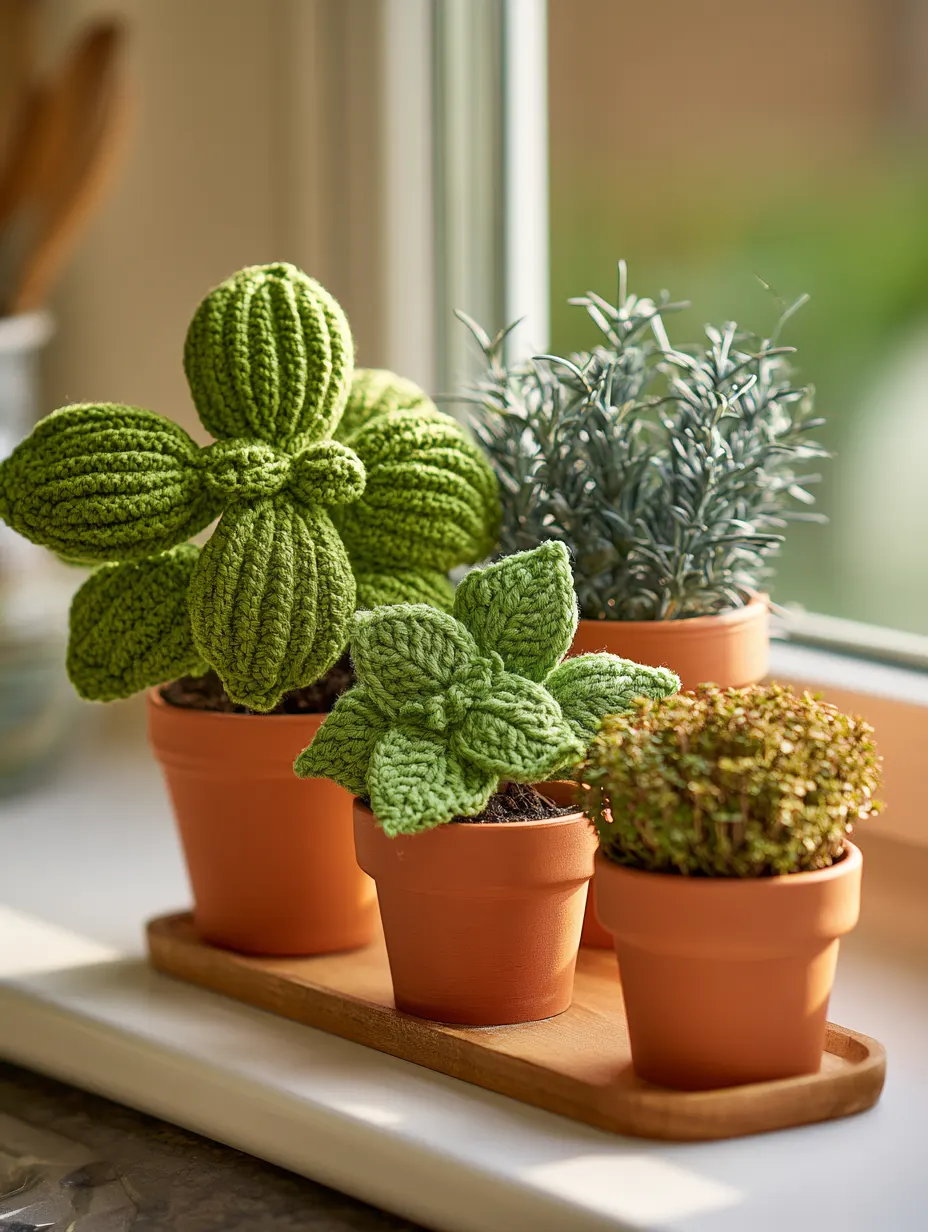
A small collection of individual herb plants, basil, rosemary, mint, and thyme, each worked as a botanically specific form in its correct color and placed in a small terracotta or ceramic pot, arranged together on a wooden tray as a windowsill herb garden. The window herb garden is the most domestic and the most specific of all the plant arrangements on this list because it references the specific activity of growing and using herbs in a kitchen.
In the specific greens of each herb, vivid bright green for the basil with its characteristic large rounded leaves, blue-grey-green for the rosemary with its thin needle leaves, bright fresh green for the mint with its slightly crinkled leaf texture, and warm darker green for the thyme with its tiny rounded leaf pairs, the window herb garden reads as the handmade version of the kitchen herb collection that connects the kitchen to the garden through the specific act of growing and cutting and using the same plants that appear in the cooking. Each herb plant is worked in its botanically accurate color and leaf form. Generic green for all four herbs produces a collection of small green plants. Four specific greens, each matching its herb, produces a window herb garden that anyone who cooks recognizes immediately.
Yarn: Fingering weight in four specific herb greens
Hook: 2.25 mm
Pots: Four small terracotta pots on a narrow wooden tray
Display: On a kitchen windowsill where it occupies the space that a real herb garden would occupy
Room quality added: The window herb garden brings the specific quality of a kitchen that is connected to the garden and to the seasonal cycle of growing and using living plants, the domestic intelligence of a home that knows where food comes from
Making Crochet Plants That Look Real
Color Is the First Botanical Decision
The botanical accuracy of a crochet plant is determined more by its color than by any construction detail. A monstera in the wrong green reads as a generic leaf regardless of how precisely the fenestrations are placed. A monstera in the specific deep tropical green of the living plant reads as a monstera before any other detail is noticed. Before choosing yarn for any plant pattern on this list, hold the candidate yarn beside a photograph of the real plant in natural light. If the yarn reads as the same color as the plant in the photograph, it is the correct yarn. If it reads as adjacent to the correct color, it will produce a plant that looks approximately right. Approximately right is not the same as botanically accurate, and the difference is visible in the finished object at a distance of three feet. The correct color and the adjacent color are separated by one shade choice. The difference in the finished plant is the difference between an object that reads as a plant and an object that reads as a yarn object shaped like a plant.
Armatures, Stiffening, and Stability
A crochet plant that cannot support its own form is not a plant. It is a flat or drooping textile object that requires constant repositioning. Every crochet plant on this list that has leaves, stems, or fronds requires an internal armature of wire or a structural stiffening treatment to maintain its intended form. Fine green-coated floral wire is the correct wire for small leaves and thin stems: it is light enough not to add significant weight to the finished plant and strong enough to hold a gentle curve permanently. Thicker gauge wire is required for structural elements that must support weight, the trunk of the fiddle leaf fig, the main stems of the fern arrangement. Fabric stiffener applied to flat leaves and allowed to dry pinned flat produces a leaf that holds its shape through the full range of normal indoor display conditions. A plant without its armature is a construction decision left incomplete.
Displaying Crochet Plants for Maximum Room Impact
The placement of a crochet plant is as important as its making. A crochet plant placed incorrectly loses most of its room quality. The monstera leaf reads at its fullest when it is placed upright where the light falls across its surface and the fenestrations produce small light patterns on the surface behind it. The trailing pothos reads at its fullest when it is placed at a height that allows its trail to hang freely rather than coiling on the surface below the shelf. The hanging planter reads at its fullest at eye level or slightly above, where the plant occupies the same visual plane as the faces of the people in the room. The cherry blossom branch reads at its fullest in a corner where its branching structure can be seen against a plain wall. Each plant was made for a specific kind of place. Find that place. The plant will do the rest.
Frequently Asked Questions
What yarn is best for crochet plants?
A firm, smooth cotton in the appropriate weight for the specific plant scale produces the most botanically accurate crochet plants because cotton’s fiber structure holds the stitch definition that makes individual leaf forms and surface textures readable at display distance. Fine cotton thread in fingering weight produces the correct scale for small plants: succulents, air plants, lavender stems, herb plants. DK weight cotton produces the correct scale for medium plants: trailing pothos leaves, snake plant leaves, aloe leaves, fern fronds. Bulky weight or cotton rope produces the correct scale for large structural elements: hanging planters, pampas grass plumes, thick trunks. A yarn with too much texture or halo obscures the stitch definition that produces the botanical surface details. A smooth cotton at the correct weight and the correct color is the baseline. Everything else, the wire, the stiffener, the stuffing, the pot, serves the plant that the smooth cotton creates.
How do I make crochet leaves look realistic?
Four practices produce the most realistic crochet leaves. First, choose the correct green: the specific botanical green of the plant being made rather than a generic green from the yarn range. Second, add surface detail after the leaf is complete: vein lines embroidered with a tapestry needle, color variation along the leaf margin worked as a carried color during construction, or surface texture added through surface slip stitches. Third, block every flat leaf aggressively: pin flat on a blocking mat, apply a small amount of fabric stiffener, and allow to dry completely before removing the pins. Fourth, position the leaf with an internal wire that holds it at the correct angle for the specific plant: a monstera leaf at a slight upward angle, a pothos leaf hanging naturally downward, a fiddle leaf fig leaf curving slightly forward from the stem. The shape of the leaf in display is as much a botanical detail as the color or the surface texture.
Can I sell crochet plants?
Yes. Crochet plants sell consistently at craft markets, online shops, and through social media in the home decoration category. The succulent collection and the trailing pothos sell at the most accessible price point and move quickly because they are immediately understood as decorative objects with a clear display context. The larger statement plants, the fiddle leaf fig, the cherry blossom branch, the pampas grass bundle, sell at a higher price point to buyers who are furnishing a specific space and want a handmade object of genuine decorative scale and ambition. The window herb garden sells as a set rather than as individual plants, and the set price should reflect the collective making time rather than the individual plant price multiplied by four. Photograph all crochet plants in their intended display context, in a pot on a shelf, in a vase on a table, hanging from a ceiling hook, rather than against a plain background. The display context shows the buyer what the plant will do for their room. That is the image that sells it.
How do I keep crochet plants dust-free?
Crochet plants in open display positions accumulate dust at the same rate as any other textile object in the home. The most effective cleaning method for most crochet plants is a gentle blast from a can of compressed air directed at the plant from a distance of twenty to thirty centimeters, which dislodges surface dust without disturbing the plant’s shape or its armature positioning. A soft makeup brush or a clean, dry paintbrush gently swept across flat leaf surfaces removes surface dust from stiffened leaves without disturbing the stiffened form. Plants with dense surface textures, the pampas grass plume, the succulent rosette, the fern frond, can be gently shaken in a paper bag to dislodge accumulated dust before the compressed air treatment. Do not wash wire-armature plants: the wire inside will rust when wet and the rust will eventually stain the yarn from the inside outward in a way that no surface cleaning removes. Dust rather than wash. Dust regularly enough that the dust accumulation never becomes significant.