There is something exactly right about a mouse in a book. The mouse is the creature of small found spaces, of warmth borrowed from larger worlds, of the specific patience required to live well in the margins of things. A book has margins. A book has the particular quiet of a world that exists only when someone is paying attention to it. A mouse understands both of these qualities instinctively, which is why a crochet mouse bookmark feels less like a decoration and more like a discovery: the mouse was always going to end up there, in the pages of the book being read, and it is only the maker who has finally made the arrangement official. These twenty-one patterns make mice for every reading life, from the simplest flat mouse a beginner completes in one sitting to the most elaborate mouse with its own tiny library shelf.
This list covers 21 crochet mouse bookmark patterns across every skill level, each with construction notes, yarn guidance, and the specific character that makes each mouse worth making and placing in the book currently on the nightstand.
1. The Round-Eared Mouse
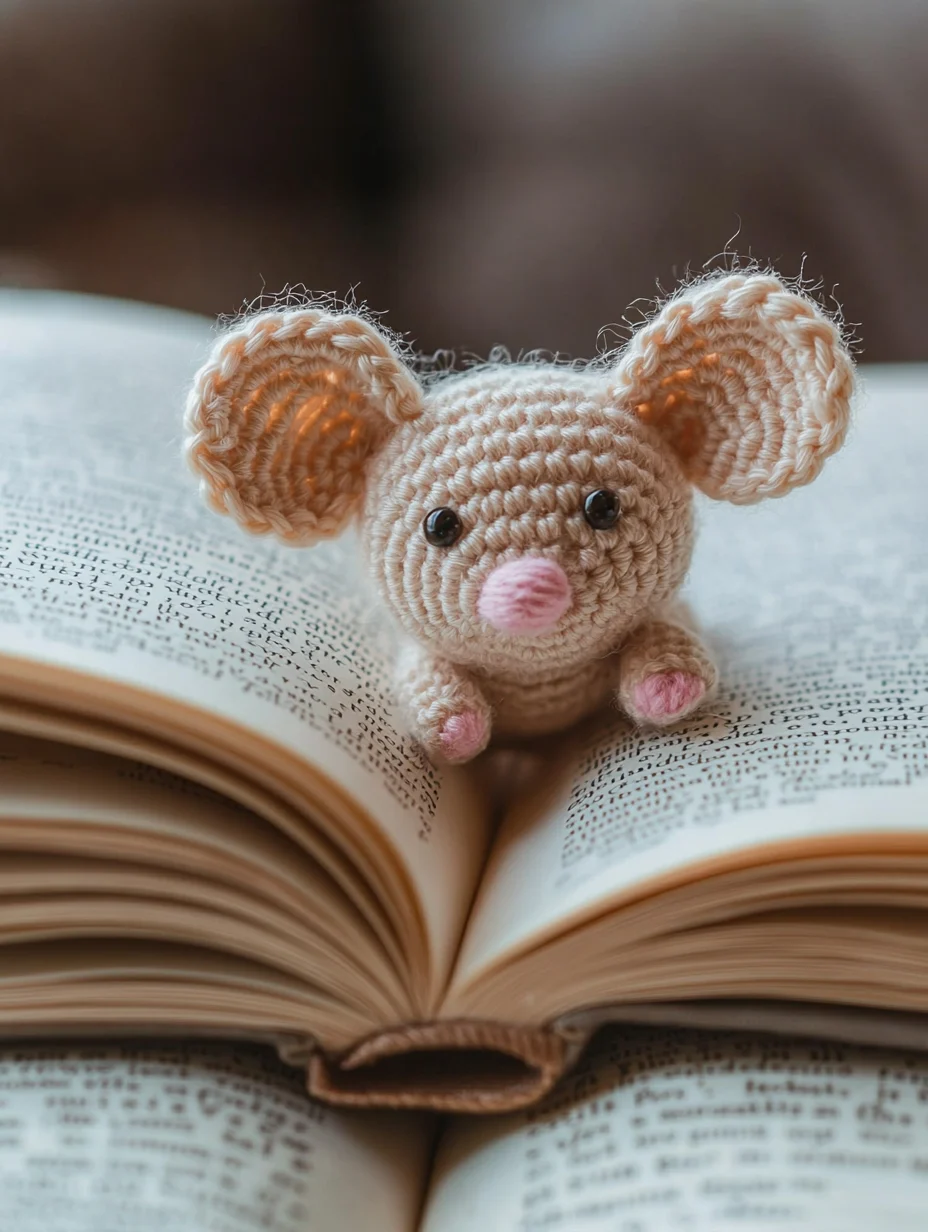
A flat bookmark mouse with small round ears instead of the traditional pointed ones, worked as two small circles attached at the top of the head rather than two triangles. The round ear is a single construction change that produces a mouse of completely different character from its pointed-eared counterpart.
In a warm cream fine cotton with small round ears in a soft dusty pink the round-eared mouse reads as younger and more tentative than the pointed-ear mouse, the round ears producing an expression of mild surprise rather than alert attention. The round ear circles are worked as small flat discs of six rounds each and attached at the upper sides of the head rather than at the top edge, which positions them as ears that have been caught mid-swivel rather than ears at full alert. This single positioning decision gives the round-eared mouse its specific quality of having just noticed something interesting and not yet decided whether to investigate.
Yarn: Fine cotton in warm cream and dusty pink
Hook: 2 mm
Time: 45 minutes to 1 hour
Skill level: Complete beginner
Character note: The round-eared mouse has the quality of a creature that is slightly surprised to find itself in a book but has decided to stay anyway
2. Mouse with a Tiny Lantern

A mouse holding a miniature crocheted lantern of approximately one centimeter, the lantern worked as a small cylinder of yellow or gold yarn with a fine wire handle, the mouse positioned as though reading by its own light source. The lantern mouse is the most narrative bookmark on this list and the one that most completely justifies the mouse’s presence in a book.
In a warm brown mouse with a tiny gold lantern constructed from a small cylinder of gold-effect thread over a wire frame the mouse with a tiny lantern is the mouse that has been reading long after the room’s lights went out, which is an activity that every serious reader recognizes and respects. The lantern cylinder is worked as a small tube of six stitches in five rounds of gold-effect thread, the wire handle bent into a small loop at the top and tucked through the yarn before the top round is closed. The lantern is attached to one of the mouse’s small front paws with a few stitches through both the lantern base and the paw, securing it at the angle of a carried object rather than a dropped one.
Yarn: Fine cotton in warm brown, gold-effect thread for lantern
Hook: 2 mm
Extra materials: Fine wire for lantern handle
Time: 1.5 to 2 hours
Skill level: Beginner to intermediate
Character note: The lantern mouse has decided that insufficient light is not a good reason to stop reading, which is the most relatable quality any bookmark can have
3. Striped Scarf Mouse
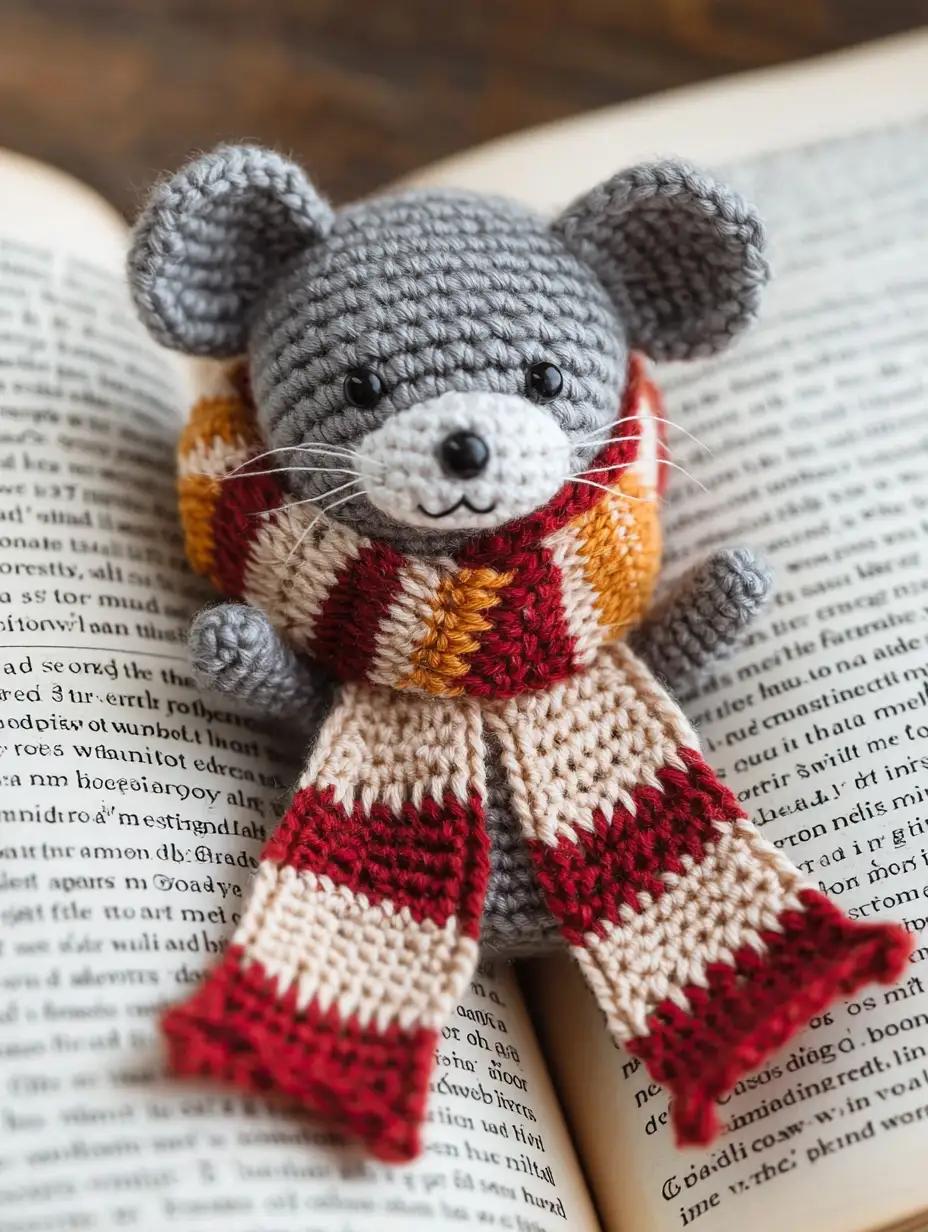
A mouse with a tiny striped scarf of two or three colors wrapped twice around its neck, the stripes worked as alternating rows of two colors in a small flat strip. The stripe pattern on the scarf is the construction detail that converts a scarved mouse into a mouse with a wardrobe opinion.
In a warm grey mouse with a tiny scarf of vivid red and natural cream stripes the striped scarf mouse is the mouse that has views about knitwear and has expressed those views through the specific striped scarf it is wearing, which is a quality that readers who also have views about knitwear find immediately sympathetic. The striped scarf strip is worked as a long thin rectangle of eight stitches in alternating rows of two colors, long enough to wrap twice around the mouse’s neck with a small tail of each end hanging free. Both ends hanging rather than tucked reads as a scarf worn with intention rather than a scarf that arrived and was secured without thought.
Yarn: Fine cotton in warm grey, vivid red, and natural cream
Hook: 2 mm
Time: 1 to 1.5 hours
Skill level: Beginner
Character note: A mouse with a striped scarf has a personal aesthetic and is not embarrassed about it
4. Hibernating Mouse
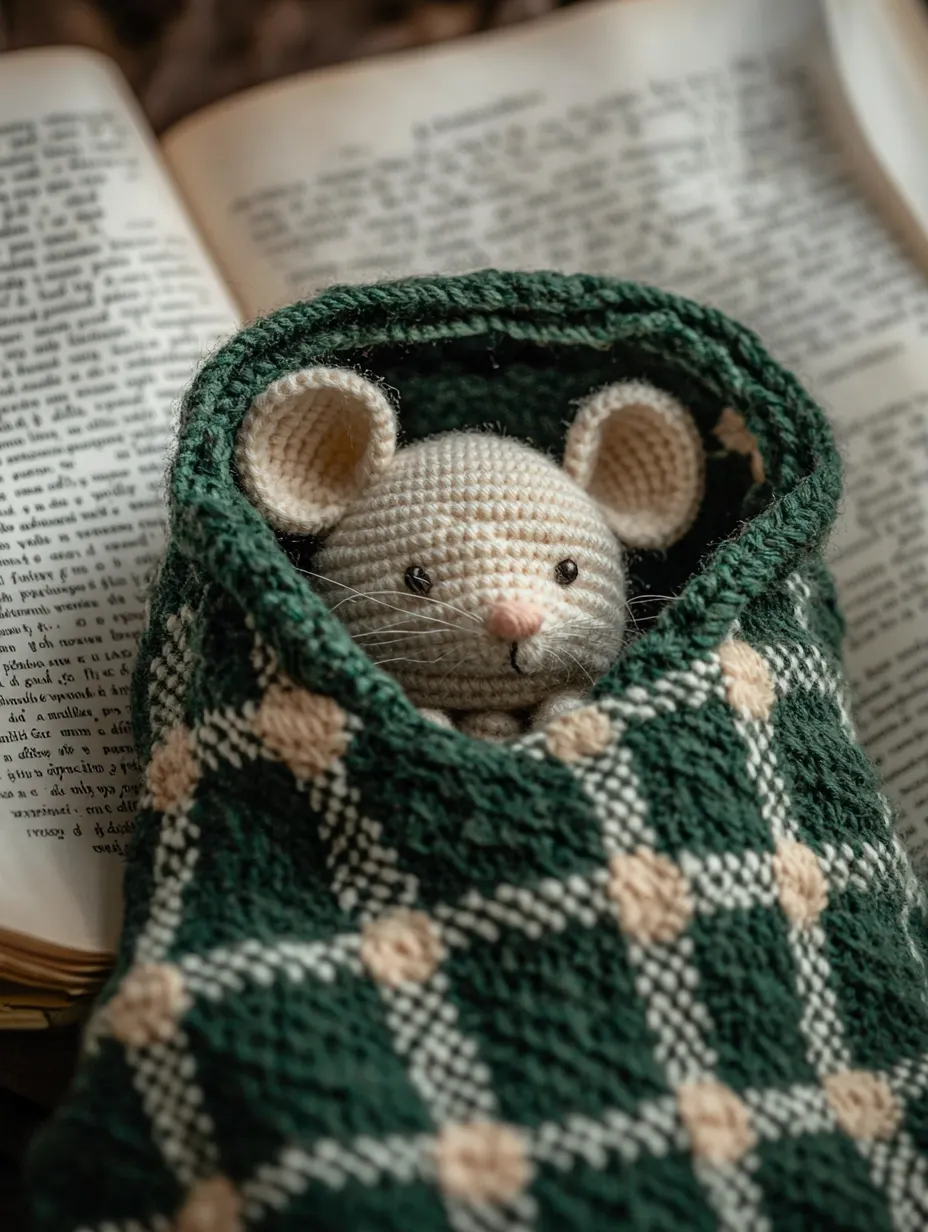
A mouse tucked inside a tiny crocheted sleeping bag of approximately five centimeters, only the head and ears visible above the sleeping bag’s top edge, the sleeping bag worked as a flat-bottomed tube in a warm plaid-inspired colorwork. The hibernating mouse is the bookmark for the reader who understands that a good book and a warm covering are the same category of comfort.
In a warm cream mouse inside a sleeping bag of deep forest green with cream plaid lines the hibernating mouse is the mouse that has read itself to sleep inside the very book it was marking, which is the specific quality of a reader who takes the activity seriously enough to plan for all outcomes including unconsciousness. The sleeping bag is worked as a simple flat-bottomed tube with a color change plaid worked in surface chain stitch after the tube is complete, the plaid lines running horizontally and vertically across the sleeping bag’s outer surface in a color that contrasts with the main tube color.
Yarn: Fine cotton in warm cream for mouse, deep forest green and cream for sleeping bag
Hook: 2 mm
Time: 2 to 2.5 hours
Skill level: Intermediate
Character note: The hibernating mouse has correctly identified that a sleeping bag in a book is a perfectly reasonable arrangement and sees no reason to explain itself further
5. Dressed-Up Tea Party Mouse

A mouse wearing a tiny party hat and holding a miniature teacup of approximately half a centimeter, the hat worked as a small cone in a vivid color with a tiny pompom at the tip. The tea party mouse is the mouse for the book being read on a slow Sunday afternoon with an actual cup of tea beside the armchair.
In a soft cream mouse with a vivid pink party hat topped with a tiny cream pompom and a miniature teacup of white fine cotton worked as a small cylinder the tea party mouse is the bookmark that makes the reading session feel like an occasion rather than a habit, which is the specific quality that a mouse in a party hat brings to an afternoon book. The miniature teacup is the most challenging element at this scale: a small cylinder of four stitches in three rounds of white fine cotton, with a tiny handle loop of chain stitches attached at one side and a small round base disc attached at the bottom.
Yarn: Fine cotton in soft cream, vivid pink for hat, white for teacup
Hook: 2 mm and 1.5 mm for the teacup
Time: 2 to 2.5 hours
Skill level: Intermediate
Character note: The tea party mouse considers every reading session an occasion worth dressing for, which is the correct attitude toward both reading and tea
6. Detective Mouse

A mouse wearing a tiny deerstalker hat in a tweed-effect yarn and holding a miniature magnifying glass of fine wire and clear thread, the detective mouse that lives specifically in the mystery novel being read this week. The detective mouse is the bookmark that commits most completely to the genre of the book it is marking.
In a warm brown mouse with a tiny deerstalker hat in a flecked brown yarn and a miniature magnifying glass made from a small circle of fine wire with a short handle the detective mouse is the mouse that has read ahead and knows who did it, which gives it a specific quality of patient superiority that is entirely appropriate in a mystery bookmark. The deerstalker hat is worked as two small flat sections, a main dome and a small brim extension at front and back, assembled and attached to the head. The magnifying glass wire circle is approximately eight millimeters in diameter, formed from fine jewellery wire bent into a circle with a short handle extension of one centimeter.
Yarn: Fine cotton in warm brown, flecked brown for deerstalker
Hook: 2 mm
Extra materials: Fine jewellery wire for magnifying glass circle
Time: 2.5 to 3 hours
Skill level: Intermediate
Character note: The detective mouse has already solved the case and is staying in the book purely out of professional courtesy to the author
7. Mouse with Mittens
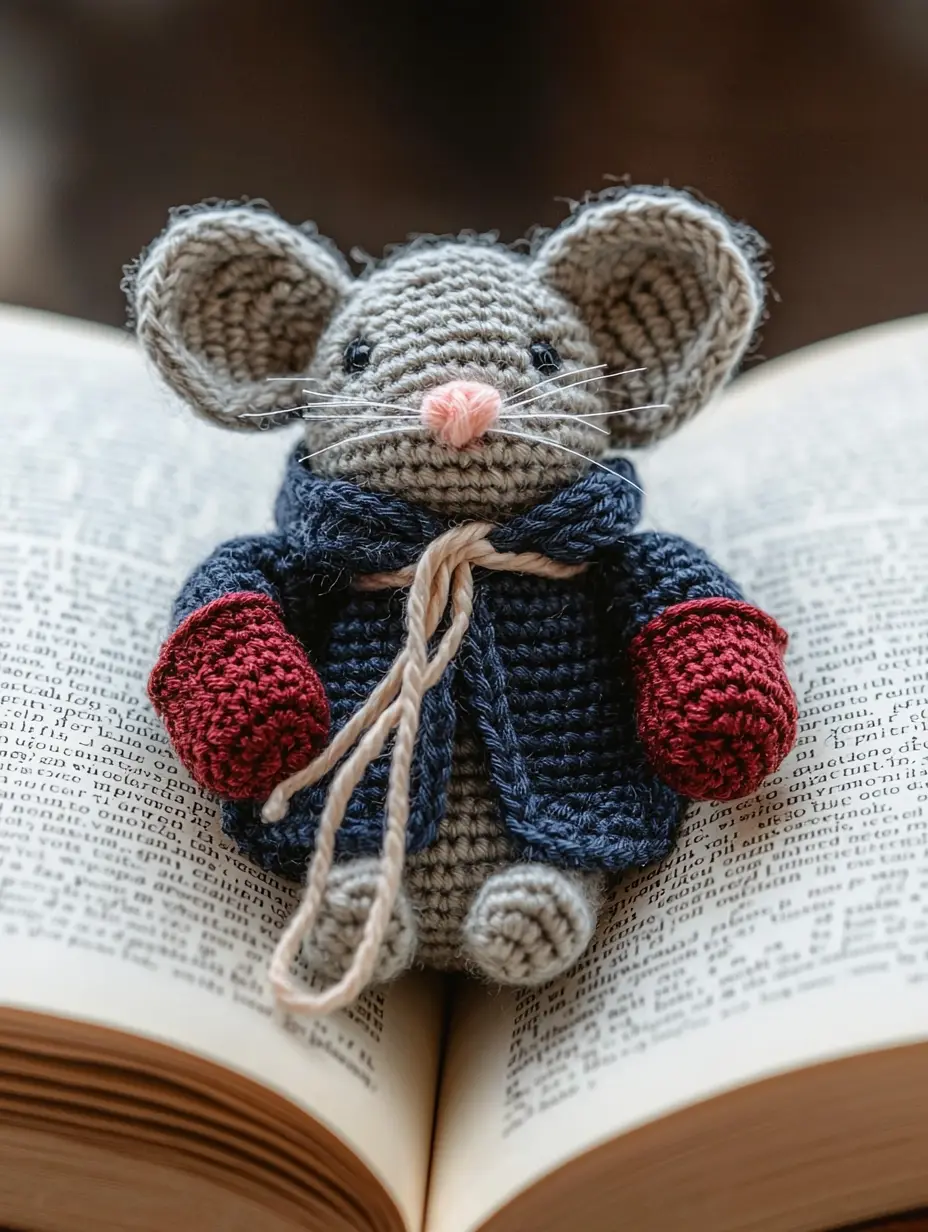
A mouse with two tiny crocheted mittens attached to its front paws by a length of thin cord threaded through the sleeves of a tiny jacket, the mittens-on-a-cord detail being the construction element that most produces the recognition of childhood winter mornings. The mitten mouse is the winter bookmark, the one for January reading.
In a warm grey mouse with tiny deep red mittens attached by a cream cord threaded through the arms of a tiny navy jacket the mouse with mittens is the bookmark for the book being read in the coldest weeks of the year, when the specific memory of mittens-on-a-cord is available to everyone who has ever been a child in winter. The mittens are worked as two tiny thumb-mitten shapes of four stitches in five rounds, each with a small thumb worked as a short two-stitch branch before the main mitten is closed. The cord between them threads through the jacket’s knitted arm sections and keeps both mittens permanently attached to the mouse’s person, which is the entire point of mittens on a cord.
Yarn: Fine cotton in warm grey, deep red for mittens, navy for jacket, cream for cord
Hook: 2 mm
Time: 2.5 to 3 hours
Skill level: Intermediate
Character note: The mitten mouse has never once lost a mitten, which is the specific achievement that makes the cord system worth the construction complexity
8. Fairy Tale Mouse

A mouse in a tiny crown and a small cape of deep purple or midnight blue, the royal mouse bookmark for the fairy tale collection or the fantasy novel with a monarchy in it. The crowned mouse takes the position of the most regal creature in any book it inhabits.
In a warm cream mouse with a tiny gold crown of three points and a small cape of deep purple fine cotton the fairy tale mouse is the bookmark that arrives in the book with the specific confidence of a creature that has always been royalty and simply required the correct headwear to make this obvious. The crown is worked as a simple band of gold-effect thread with three small points worked as individual chain loops at even intervals around the band’s upper edge, fitted over the mouse’s head and secured at two points at the band’s base. The cape is a simple flat semi-circle of deep purple fine cotton attached at the mouse’s neck with a tiny gold button closure.
Yarn: Fine cotton in warm cream, gold-effect thread for crown, deep purple for cape
Hook: 2 mm
Extra materials: A tiny gold button for cape closure
Time: 2 to 2.5 hours
Skill level: Intermediate
Character note: The fairy tale mouse considers its crown a statement of fact rather than an ornament and is mildly surprised that anyone needs the crown explained to them
9. Mouse on a Swing
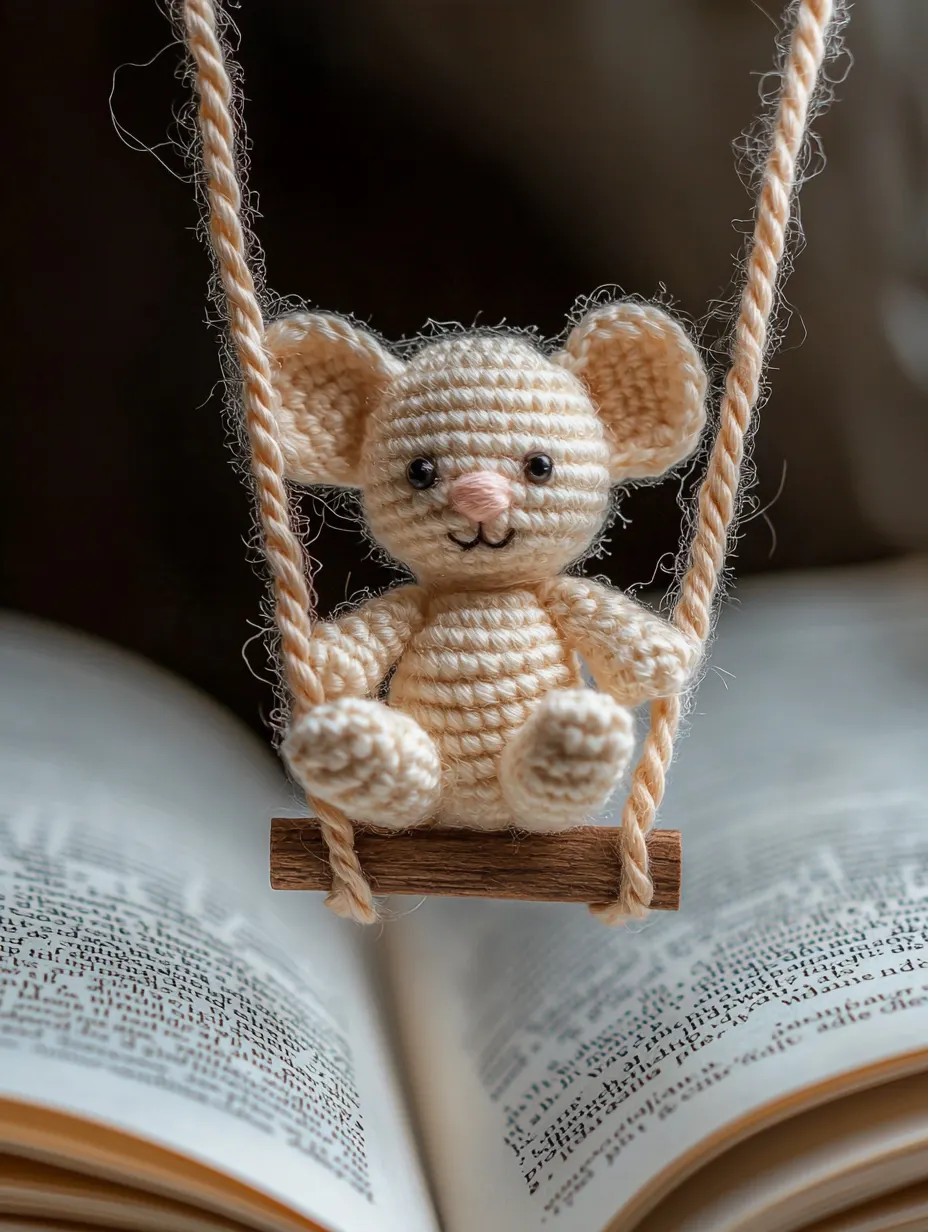
A mouse seated on a tiny swing of two thread lengths and a small wooden stick, the swing hanging from the top of the bookmark tab so the mouse appears to be swinging above the book’s open pages. The swing mouse is the most kinetic bookmark on this list, the one that moves when the reader turns a page.
In a pale cream mouse seated on a swing of natural thread and a thin wooden kebab skewer trimmed to three centimeters the mouse on a swing is the bookmark that has found the most comfortable position available in the pages of a book and has made itself a seat there, which is the quality of a creature that approaches every new environment as a potential home. The swing threads are two equal lengths of natural or cream thread, approximately four centimeters each, knotted through small holes at each end of the wooden stick seat. The upper ends of both threads are knotted together and attached to the top of the bookmark tab so the swing hangs freely below the tab top and the seated mouse swings slightly when the book is moved.
Yarn: Fine cotton in pale cream
Hook: 2 mm
Extra materials: A thin wooden stick of three centimeters, natural thread for swing cords
Time: 2 to 2.5 hours
Skill level: Intermediate
Character note: The swing mouse has correctly identified that a good position is worth engineering, and that the inside of a book is an excellent location for a swing
10. Artist Mouse with Tiny Palette
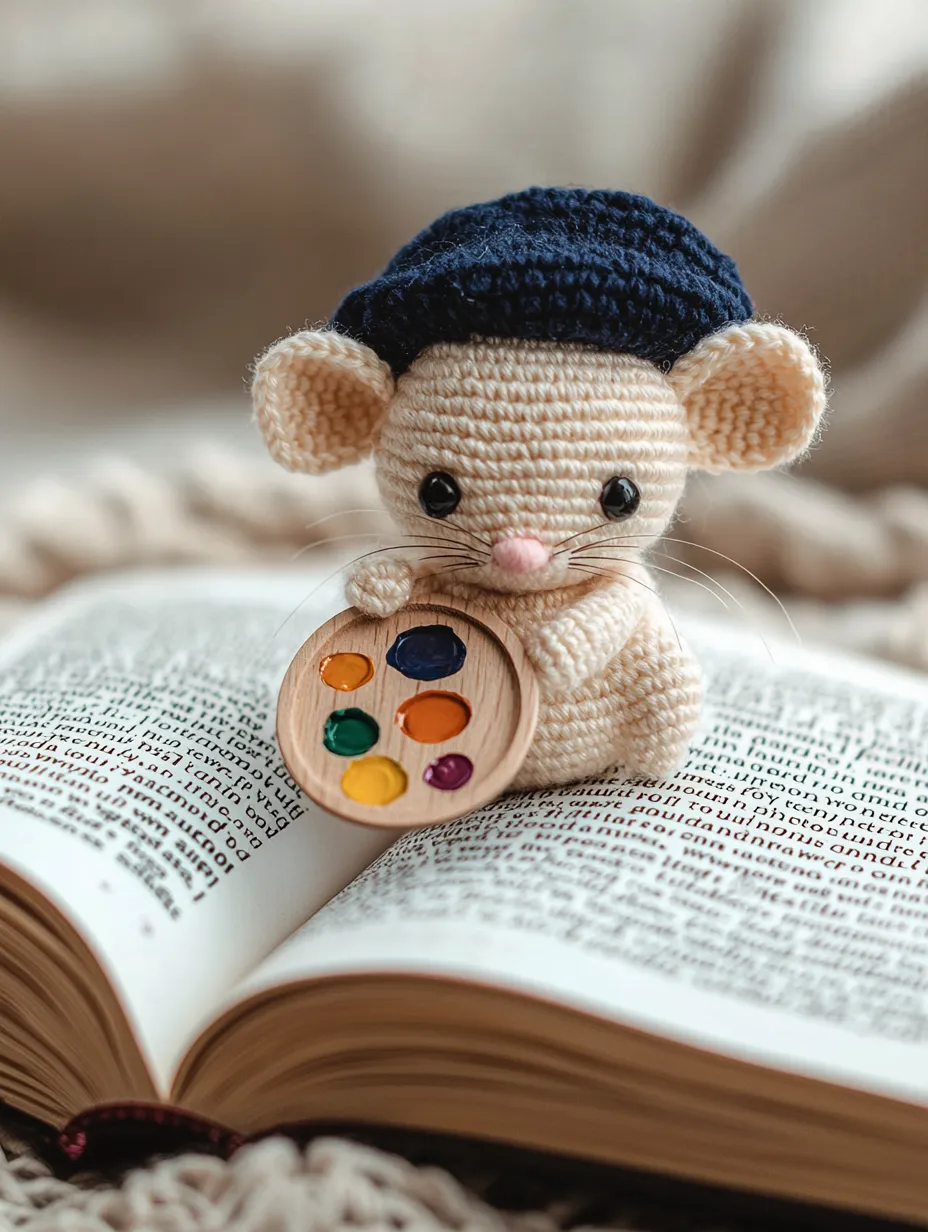
A mouse holding a tiny oval palette of approximately one centimeter with small dots of different colors on its surface, worked in a firm cotton stiffened to hold its flat oval shape, the artist mouse for the book about art or the reader who makes things when not reading. The palette is the prop that most clearly identifies a mouse’s occupation without requiring any other context.
In a warm cream mouse with a beret of deep navy and a tiny oval palette of natural cotton stiffened and painted with small dots of three or four acrylic colors the artist mouse is the bookmark for the reader who approaches books the same way they approach making things: with the specific attention of someone who is also looking at how it is constructed, not only what it contains. The beret is a small flat disc of deep navy worked in eight rounds with a slight downward brim, placed at a slight angle on the mouse’s head and secured at two points. The tiny palette is the one element that requires non-yarn materials: a small oval cut from firm craft felt or worked in stiffened cotton and decorated with tiny dots of acrylic paint in three or four colors.
Yarn: Fine cotton in warm cream, deep navy for beret
Hook: 2 mm
Extra materials: Firm felt or stiffened cotton for palette, small dots of acrylic paint
Time: 2 to 2.5 hours
Skill level: Intermediate
Character note: The artist mouse is studying the book for compositional technique and has strong opinions about the chapter structure
11. Mouse in a Hammock
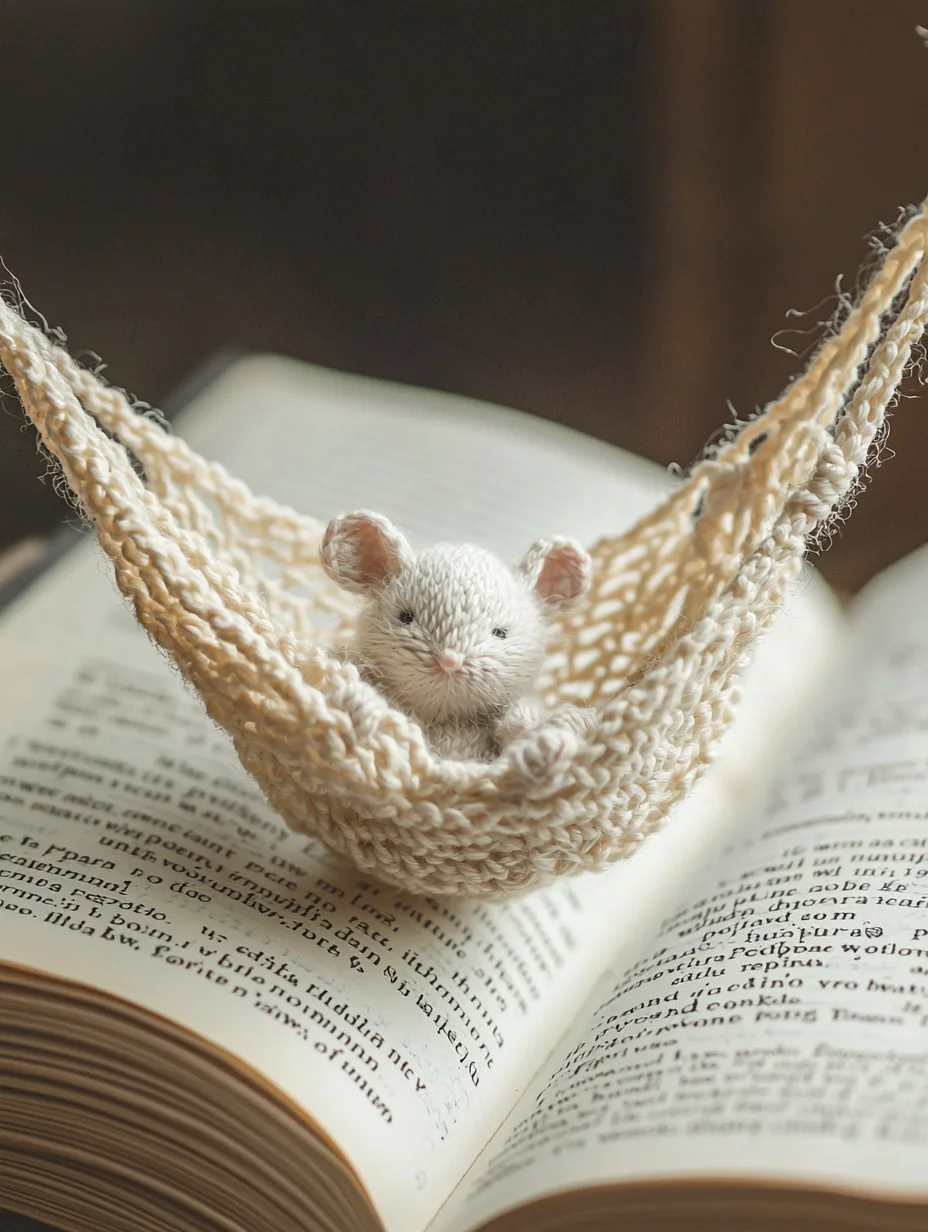
A mouse lying in a tiny crocheted hammock of approximately four centimeters, the hammock worked as a small net rectangle and suspended between two thin twigs or wooden sticks, the whole construction displayed with the hammock hanging in the book’s spine. The hammock mouse has found the most architecturally ambitious sleeping arrangement available to a bookmark.
In a soft pale grey mouse resting in a tiny hammock of cream net worked in chain and slip stitch mesh and suspended between two thin twig ends the mouse in a hammock is the bookmark that has decided the book’s spine is structural and has used it accordingly, which is the kind of practical thinking that produces great architecture and excellent rest. The hammock net is worked as a simple mesh rectangle of chain-five loops joined at each end with a short length of thread forming the suspension cord. The twig ends that anchor each suspension cord give the hammock its horizontal structure and serve as the display element that holds the hammock open when the book is closed.
Yarn: Fine cotton in soft pale grey, cream for hammock net
Hook: 2 mm
Extra materials: Two small thin twigs or wooden sticks
Time: 2 to 2.5 hours
Skill level: Intermediate
Character note: The hammock mouse has solved the problem of where to rest between chapters in the most elegant way available
12. New Year Mouse with Confetti

A mouse wearing a small silver or gold party hat and holding a tiny noisemaker of twisted wire and a small piece of metallic fringe, with tiny paper confetti dots glued to its hat and surrounding its feet. The New Year mouse is the seasonal bookmark that appears in the book being started on January first and that communicates the specific optimism of a year that has not yet had anything go wrong in it.
In a warm cream mouse with a tiny silver pointed party hat and a small metallic noisemaker the New Year mouse is the bookmark for the book chosen specifically to begin the reading year, the one selected with the intention that this will be the year more books get finished than started, which is the perennial resolution of every reader who has more books than time. The party hat is a small silver or gold fine cotton cone stiffened with fabric stiffener and decorated with a strip of metallic thread trim at the base. The confetti is the finishing detail: tiny circles of gold and silver paper punched from metallic card and applied with a small dot of craft glue to the hat surface and the mouse’s base platform.
Yarn: Fine cotton in warm cream, silver or gold thread for hat
Hook: 2 mm
Extra materials: Fabric stiffener, metallic trim, tiny paper confetti
Time: 2 to 2.5 hours
Skill level: Intermediate
Character note: The New Year mouse is celebrating the book being started rather than the year, which is the correct priority
13. Garden Mouse with Tiny Trowel

A mouse in a small gardening apron holding a miniature trowel of approximately two centimeters, the trowel worked in a silver-grey yarn stiffened to hold its flat blade shape or cut from a small piece of thin aluminum foil shaped with scissors. The garden mouse is the bookmark for the seed catalogue being studied in February and for every gardening book read between seasons.
In a warm brown mouse wearing a tiny green apron tied at the back and holding a miniature trowel the garden mouse is the bookmark for the reader who is also a grower, the person whose reading list and their garden are managed with the same combination of optimism and seasonal realism. The tiny apron is a small flat rectangle of forest green fine cotton with two thin ties at the top corners threaded around the mouse’s neck and tied at the back. The trowel is the element that requires creative material choices: a small flat blade of silver-grey yarn stiffened to a firm flat surface, or more durably a small trowel shape cut from thin aluminium foil and gently shaped with a small handle fold at one end.
Yarn: Fine cotton in warm brown, forest green for apron
Hook: 2 mm
Extra materials: Thin aluminium foil or stiffened yarn for trowel
Time: 2 to 2.5 hours
Skill level: Intermediate
Character note: The garden mouse is reading for practical information and will be putting what it learns into immediate use as soon as the soil warms
14. Storyteller Mouse
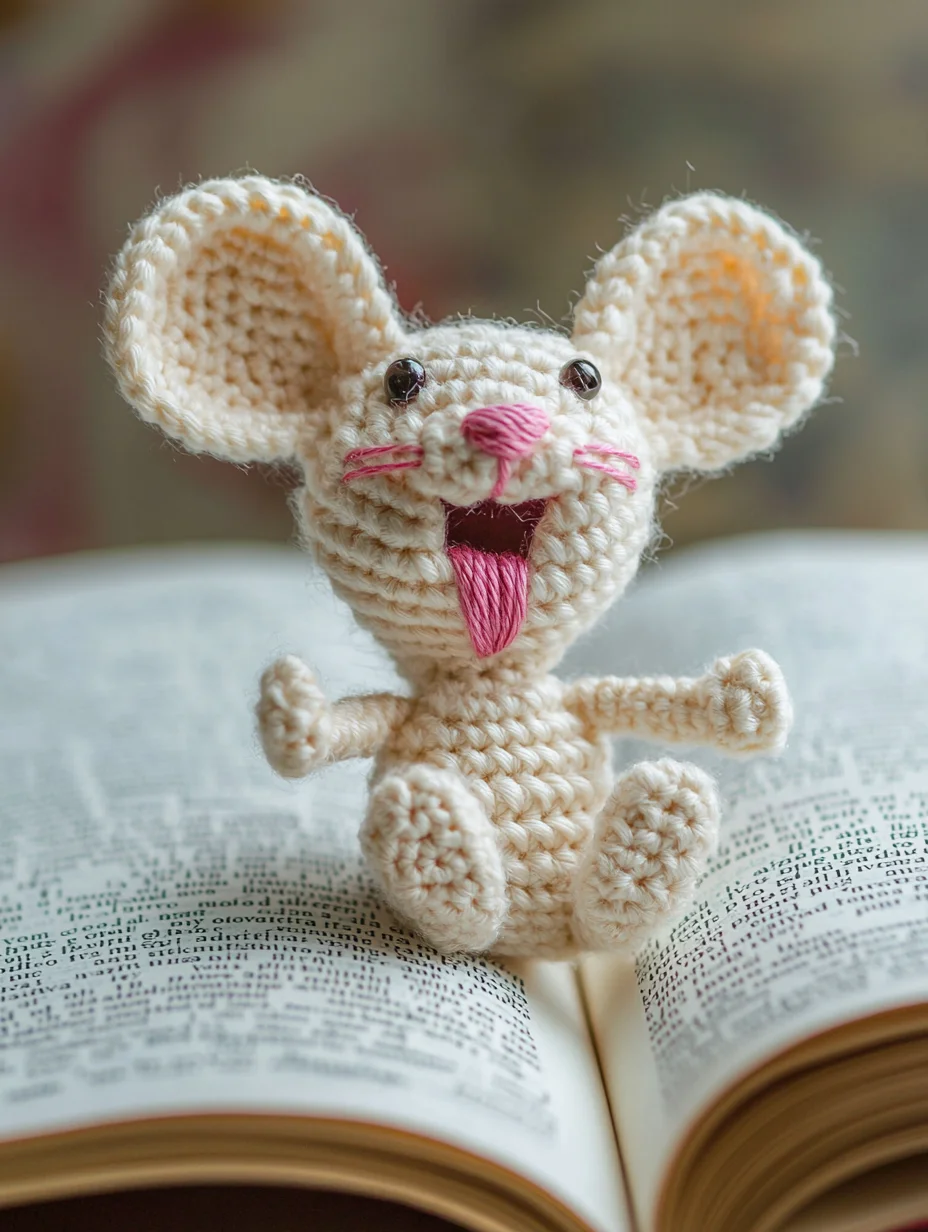
A mouse with its mouth open in a small round O shape and one paw raised as though mid-sentence, the expression and gesture together producing the unmistakable quality of a creature that is in the middle of telling a very good story and will not be interrupted. The storyteller mouse is the bookmark for the reader who also writes.
In a warm cream mouse with an embroidered open-mouth expression of a small round O of satin stitch and one front paw attached at a raised angle the storyteller mouse is the mouse that has read this book before and can tell you exactly what happens next, which is either the most useful or the most annoying quality a bookmark can have depending on whether the reader wants to know. The open-mouth expression is worked in satin stitch as a small oval of deep pink or coral thread, the stitches filling the oval completely so the mouth reads as open rather than as an oval outline. The raised paw is attached at the shoulder joint at a forward-and-upward angle rather than hanging down alongside the body.
Yarn: Fine cotton in warm cream
Hook: 2 mm
Extra materials: Deep pink or coral thread for open-mouth embroidery
Time: 1.5 to 2 hours
Skill level: Beginner to intermediate
Character note: The storyteller mouse has an opinion about the plot and the confidence to express it, which makes it the best kind of reading companion
15. Music Mouse with Tiny Instrument
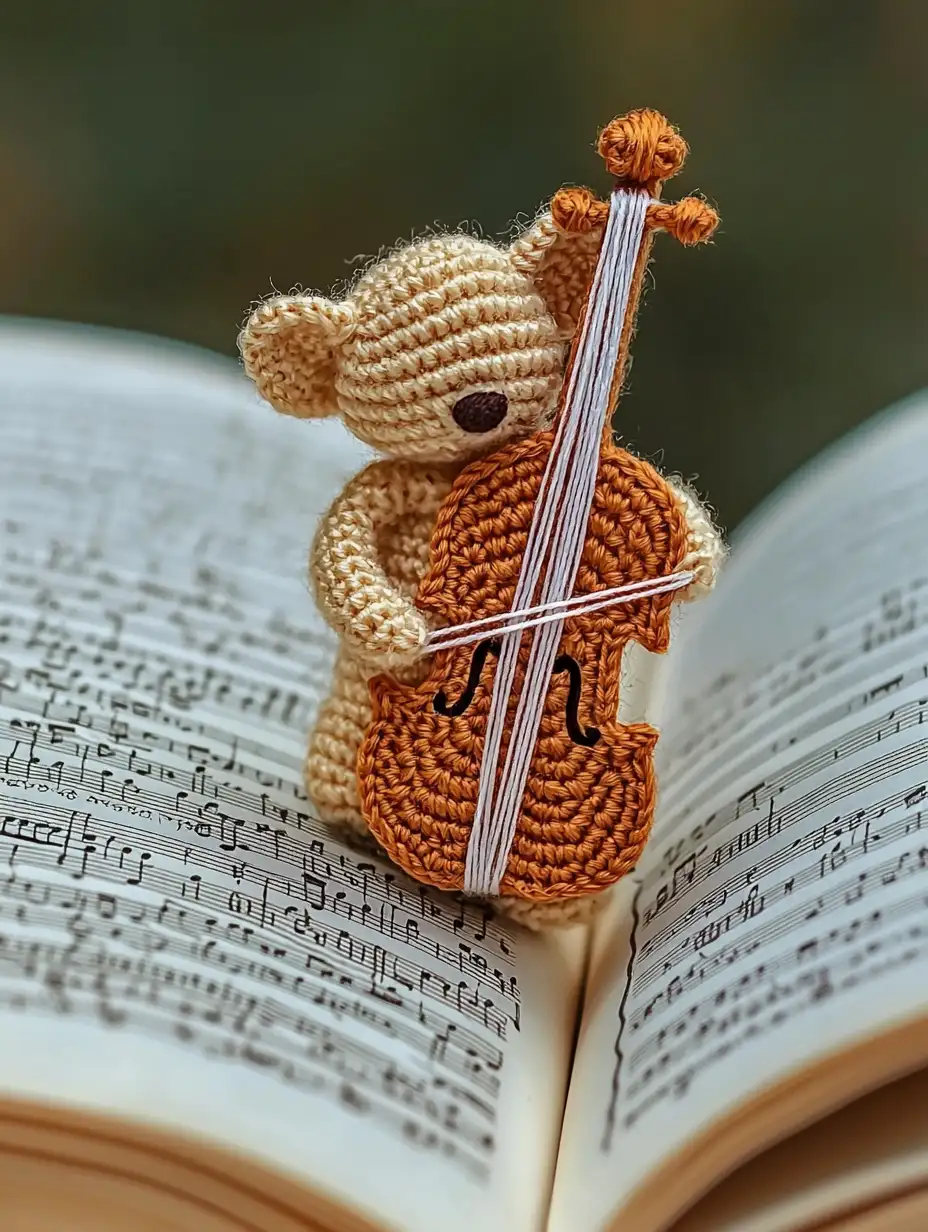
A mouse holding a miniature instrument of the maker’s choice: a tiny violin worked as a flat figure-eight shape of cream yarn, a small guitar of warm brown with fine thread strings, or a miniature accordion of alternating black and cream stripes. The music mouse is the bookmark for the biography of a composer or the novel where music is a central character.
In a deep brown mouse holding a tiny cream and warm wood violin shape with three fine thread strings the music mouse is the bookmark for the book where sound is the subject, the biography of a musician, the novel set in a concert hall, the history of an instrument, the kind of book that makes the reader want to put it down and listen to something before continuing. The tiny violin is worked as a flat figure-eight shape of approximately two centimeters in natural cream, the upper and lower bouts of different sizes, stiffened with fabric stiffener and dried flat before three fine thread strings of natural thread are glued or stitched across the surface at equal intervals.
Yarn: Fine cotton in deep brown for mouse, natural cream for violin
Hook: 2 mm
Extra materials: Fine thread for violin strings, fabric stiffener
Time: 2.5 to 3 hours
Skill level: Intermediate
Character note: The music mouse is mid-performance and marks the page at the exact measure where it stopped playing, which is considerate to everyone
16. Mouse with a Tiny Map
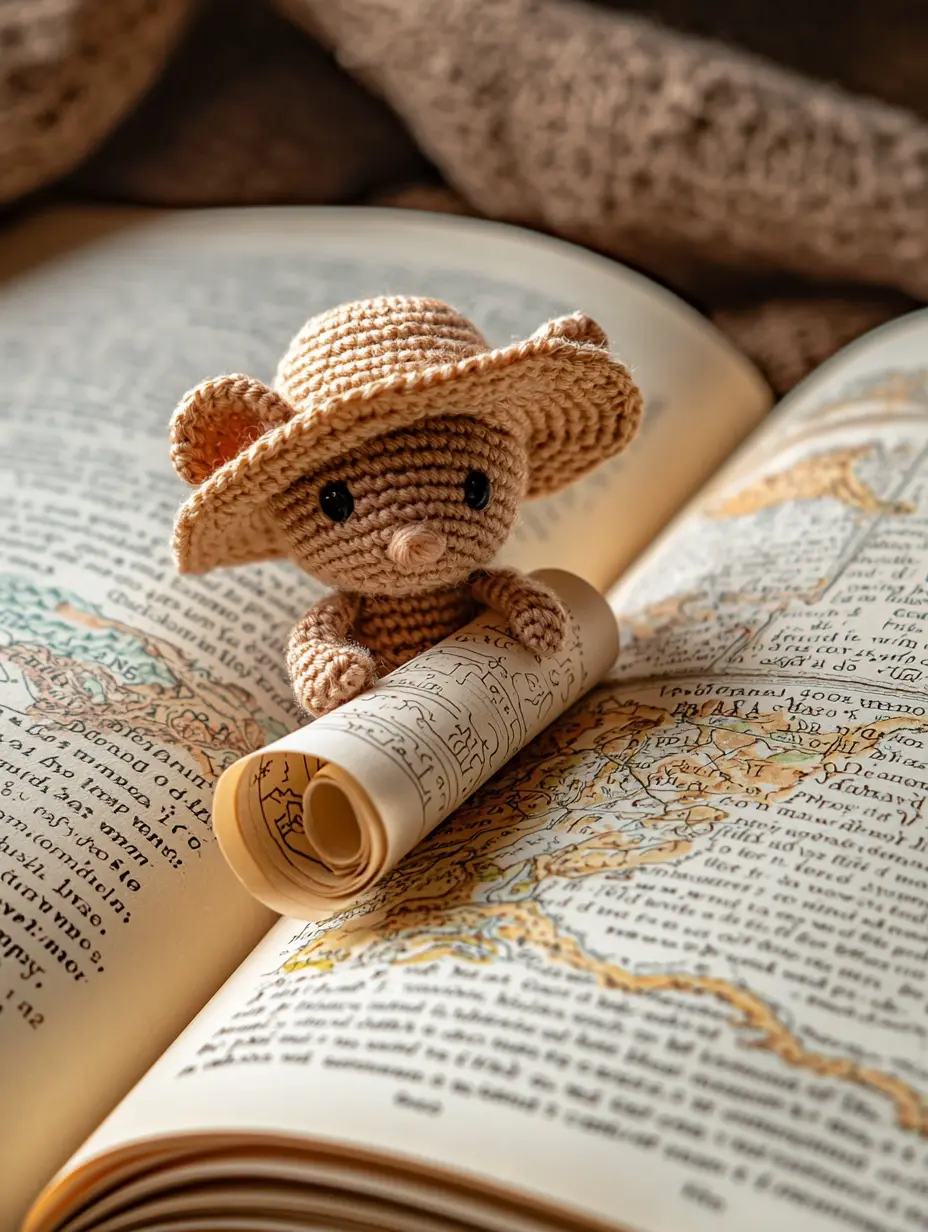
A mouse holding or examining a tiny scroll of paper approximately two centimeters when unrolled, the scroll decorated with a simple hand-drawn map of squiggly lines and an X, the explorer mouse for the travel narrative, the adventure story, the fantasy with detailed geography. A mouse with a map has a destination and a plan.
In a warm brown mouse wearing a small explorer’s hat of tan fine cotton and holding a tiny unrolled scroll of cream paper the mouse with a tiny map is the bookmark for the book where the journey is the point, where the reader follows a route across real or imagined geography and the map at the front of the book is consulted as often as the text. The tiny scroll is the element that requires non-yarn materials: a small strip of cream watercolor paper approximately two by four centimeters, lightly aged with a pale brown tea wash, rolled from each short end toward the center and tied with a length of natural thread when not displayed. The map is drawn on the paper with a fine-tipped brown pen before the paper is aged: a coastline, a river, a forest mark, an X.
Yarn: Fine cotton in warm brown, tan for explorer’s hat
Hook: 2 mm
Extra materials: Small cream paper for map scroll, fine brown pen, natural thread
Time: 2 to 2.5 hours
Skill level: Intermediate
Character note: The map mouse knows exactly where it is going and is keeping the X to itself until it gets there
17. Librarian Mouse with Tiny Stamp

A mouse wearing small wire spectacles and holding a miniature rubber stamp of approximately half a centimeter, the librarian mouse that lives specifically in the book being borrowed rather than owned, marking the loan with the same authority as any library professional. The librarian mouse is the most institutionally correct bookmark on this list.
In a warm grey mouse with wire spectacles and a tiny stamp made from a small eraser end and a fine wood handle the librarian mouse is the bookmark that already knows the due date and will not let the reader forget it. The wire spectacles are bent from fine jewellery wire into two small circles of four to five millimeters connected at the center bridge and hooked over the mouse’s nose before the face is finished, the wire ends bent behind the head. The tiny stamp is constructed from the eraser end of a pencil cut to approximately five millimeters in height and attached to a small length of toothpick as the handle, the stamp base left blank since no stamp impression at this scale would be readable, and the stamp reading as a stamp entirely from its shape and the authority of the librarian holding it.
Yarn: Fine cotton in warm grey
Hook: 2 mm
Extra materials: Fine wire for spectacles, small eraser end and toothpick for stamp
Time: 2.5 to 3 hours
Skill level: Intermediate to advanced
Character note: The librarian mouse has no opinion about what the reader chooses to read but a great many opinions about when it must be returned
18. Mouse in a Tiny Envelope
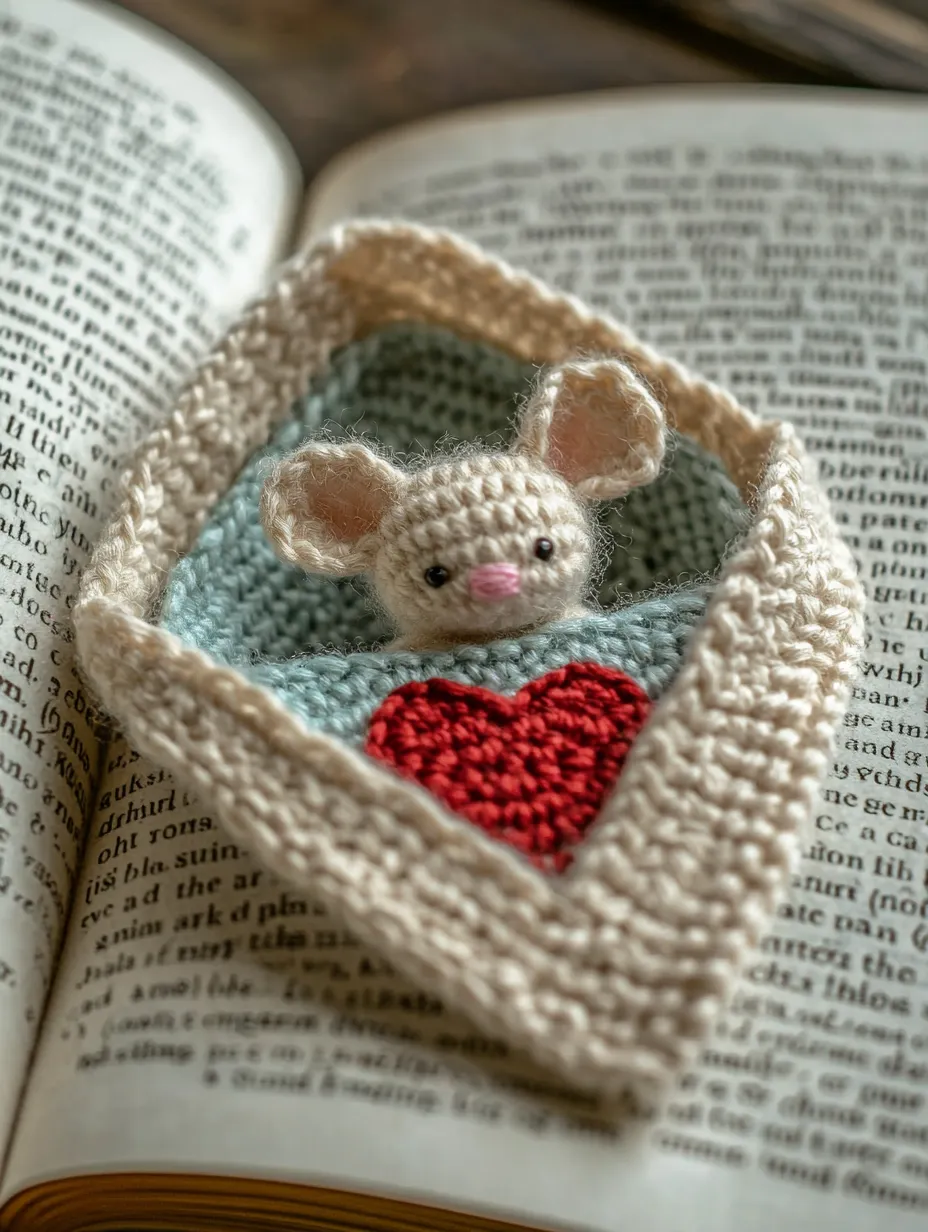
A flat mouse worked to fit inside a tiny crocheted envelope of approximately six by four centimeters, the envelope flap open and the mouse’s head and ears visible above the envelope’s top edge, displayed with the envelope tucked between the pages. The envelope mouse is the bookmark that also reads as a letter.
In a soft cream mouse inside a tiny cream envelope with a pale blue envelope interior lining and a small red heart seal on the flap the mouse in an envelope is the bookmark for the book of letters, the epistolary novel, the biography that relies on correspondence, any book where communication across distance is the central activity. The envelope is worked as a flat rectangle with a triangular flap at the top edge, the interior lining worked in a contrasting color on the flap’s reverse face so it is visible when the flap is open. The red heart seal is a tiny embroidered satin-stitch heart of three to four millimeters on the closed flap center, worked after the envelope is complete.
Yarn: Fine cotton in soft cream and pale blue for envelope lining
Hook: 2 mm
Extra materials: Red thread for heart seal embroidery
Time: 2 to 2.5 hours
Skill level: Intermediate
Character note: The envelope mouse is a letter that has never been sent, which is the most interesting kind of letter
19. Celestial Mouse with Star Wand

A mouse holding a tiny star wand of wire and gold thread, wearing a small cape of deep midnight blue with tiny embroidered stars, the celestial mouse for the fantasy novel, the astronomy book, the poetry collection with the night sky as its recurring subject. The star wand mouse is the most magical bookmark on this list.
In a pale cream mouse wearing a deep midnight blue cape with tiny embroidered gold stars and holding a star wand of fine wire with a small gold star at the tip the celestial mouse is the bookmark that has arrived in the book from the specific darkness between constellations and finds the pages an adequate if temporary residence. The cape is a simple flat semi-circle of deep midnight blue fine cotton with tiny gold star shapes embroidered at intervals across its surface, each star four to five millimeters and worked as four crossing satin stitches. The star wand is a length of fine wire of approximately three centimeters with a small five-pointed star shape bent from a single wire loop at the tip and wrapped with gold-effect thread to fill the star form.
Yarn: Fine cotton in pale cream, deep midnight blue for cape
Hook: 2 mm
Extra materials: Fine wire for star wand, gold-effect thread, gold thread for cape stars
Time: 2.5 to 3 hours
Skill level: Intermediate
Character note: The celestial mouse is granting one wish per chapter, which is a generous rate for a bookmark
20. Vintage Suitcase Mouse

A mouse sitting on or beside a tiny crocheted suitcase of approximately two centimeters, the suitcase worked as a small flat box shape in a warm tan or deep teal with a fine leather-look trim and a tiny latch, the traveller mouse for the memoir, the immigration story, the novel where leaving is the first and most important event. A mouse with a suitcase has somewhere to be.
In a warm cream mouse beside a tiny tan suitcase with fine brown trim lines and a small brass-colored button latch the vintage suitcase mouse is the bookmark for the book where everything begins with a departure: the suitcase packed, the door closed, the particular silence of a house that a person has just left for the last time, which is the most significant kind of silence in any narrative. The suitcase is worked as a small flat box of approximately two by one by one centimeters in tan DK weight, the box sides seamed firmly and the lid worked as a separate flat rectangle attached at one long edge as a working hinge. The brown trim lines are embroidered in surface chain stitch around each face of the box after completion.
Yarn: Fine cotton in warm cream, tan DK for suitcase
Hook: 2 mm for mouse, 3.5 mm for suitcase
Extra materials: A small gold-tone button for suitcase latch
Time: 3 to 3.5 hours
Skill level: Intermediate to advanced
Character note: The suitcase mouse has packed exactly what it needs and nothing it does not, which is the most difficult kind of packing and the sign of an experienced traveller
21. Mouse Holding the Page Corner

A mouse constructed specifically to wrap around the corner of a page rather than sit between pages, the body worked as two flat sections that sandwich the page corner between them, the mouse’s paws appearing to grip the corner from both front and back. The corner mouse is the bookmark that holds on, the most determined page-marker on this list.
In a warm grey fine cotton worked as two flat mirror-image mouse halves seamed together along all edges except the corner-insertion opening the mouse holding the page corner is the bookmark that has decided the page corner is the correct anchor point for a creature of its commitment to the reading task, and is demonstrating this decision with both paws. The two flat halves are worked identically as simple flat mouse profiles, front-facing and back-facing versions of the same shape, seamed along the head, back, and base edges with the bottom corner left open as a slot into which the page corner is inserted. The mouse’s paws are embroidered on both front and back faces at the lower corners of the body, positioned to appear as though gripping the page from each side.
Yarn: Fine cotton in warm grey
Hook: 2 mm
Time: 1.5 to 2 hours
Skill level: Beginner to intermediate
Character note: The corner mouse has committed to this page with both paws and will not be dislodged by anything short of the book being finished, which is the correct level of dedication for a bookmark
Making Mouse Bookmarks That Stay and Last
Scale and Yarn Weight
The correct yarn weight for a standard mouse bookmark is fine cotton at two millimeters hook size, producing a mouse of five to seven centimeters in total height with enough stitch definition that the face details read clearly at close range. Going finer to a size ten thread at a one and a half millimeter hook produces a very small mouse for the corner mouse and the envelope mouse where compact dimensions are the construction requirement. Going heavier to a DK weight produces a mouse that is too large to sit comfortably between standard paperback pages: the bookmark pushes pages apart rather than sitting between them, which is the construction failure that converts a completed mouse into a decorative object rather than a functional one. Every mouse on this list is a functional bookmark first and a decorative object second. The scale must support the function.
The Tab That Stays Between Pages
For every mouse except the corner mouse, the tab section that slides between book pages is the element that determines whether the bookmark works as a bookmark or only as a small yarn mouse that happens to be near a book. The tab must be worked at a firm even tension and stiffened with fabric stiffener, pinned flat to a blocking mat, and dried completely before use. An unstiffened tab curls and folds rather than sliding cleanly between pages. A stiffened tab maintains its flat form through daily page-turning and normal book handling. The tab width should be a minimum of two centimeters: narrower than this and the bookmark slides out when the book is carried in a bag or tilted at a reading angle. A tab of two and a half centimeters is the practical optimum for most standard paperback and hardback formats.
Securing Accessories at Two Points
Every accessory attached to a mouse bookmark, the hat, the scarf, the prop, the cape, the instrument, requires a minimum of two attachment points to remain in position through normal handling. An accessory secured at one point rotates freely and will be found facing the wrong direction or lying flat against the mouse body after the first few page-turning sessions. An accessory secured at two points stays in the position it was placed in when the bookmark was completed, which is the position that produces the character reading the mouse is meant to have. Secure each accessory at its most structurally logical two points: the hat at front brim and back brim, the scarf at each end where it crosses, the cape at collar and mid-back, the held prop at the paw and the mouse’s shoulder. Two points of attachment is the rule for every accessory on every mouse. It adds five minutes per accessory and prevents every display problem that a mouse bookmark can develop over a reading life.
Frequently Asked Questions
What is the best yarn for crochet mouse bookmarks?
A smooth fine cotton is the most reliable yarn for mouse bookmarks across the full range of patterns on this list. Smooth cotton produces the stitch definition that makes the mouse’s face readable at close range, takes fabric stiffener correctly for the tab section and any stiffened accessory elements, washes well when the bookmark accumulates the general grime of a reading life, and is available in a full color range that supports every seasonal and character variation on this list. Avoid textured or fuzzy yarns for the mouse body itself: a textured yarn obscures stitch definition and makes face embroidery difficult to position accurately against a surface whose stitch lines are not clearly visible. Textured or specialty yarns are appropriate for specific accessory elements, the flecked deerstalker, the mohair cape, the velvet-effect tiny blanket, where the texture serves the character reading of the accessory rather than the overall mouse.
How do I make the mouse face look expressive?
Three elements determine a mouse bookmark’s facial expression and all three must be placed with pins before being committed with a needle. The eyes should be small seed beads or safety eyes of four to six millimeters, placed low on the face below the mathematical center and slightly wider apart than feels standard: this low-wide placement reads as young and curious rather than alert and suspicious. The nose is a small French knot of pale pink thread or a tiny seed bead placed centered and just below the eyes. The optional mouth is two small stitches meeting at a center point below the nose, angled upward for a pleasant expression and horizontal for a neutral one. The storyteller mouse requires an open-mouth satin stitch oval. The grumpy face requires downward-angled eyebrow embroidery above the eyes. Establish every element with pins before sewing. An expression placed with pins and adjusted until correct takes ten minutes and produces a face that matches the intended character. An expression placed directly with a needle produces a face that the maker must live with permanently.
Can I make mouse bookmarks to sell?
Mouse bookmarks sell well at craft markets, online shops, and through social media, particularly when photographed in context in an actual open book rather than displayed in isolation. The simple flat mouse and the corner mouse sell at accessible price points and move quickly because they are immediately understood. The dressed and accessorised mice, the detective, the librarian, the celestial mouse, the fairy tale mouse, command higher prices from buyers who want a specific character for a specific book type. Seasonal mice, the winter mitten mouse for January, the New Year mouse for the reading year’s beginning, the hibernating mouse for cold reading months, sell best in the three to four weeks before their season arrives. A set of three or four coordinated mice in matching colors, offered as a reading set with a simple ribbon binding, sells at a higher combined price than three individual mice and requires less presentation thought from the buyer. Price every mouse at materials cost plus making time at a fair hourly rate and add the cost of any non-yarn materials such as wire, paper, or felt used in the accessories.
How long does a mouse bookmark take to make?
The simplest mouse on this list, the round-eared mouse, takes forty-five minutes to one hour for a maker who has completed amigurumi before. The most complex, the librarian mouse with wire spectacles and a constructed stamp, or the detective mouse with the wire magnifying glass, takes two and a half to three hours. The average mouse with a single accessory, the scarf, the hat, the lantern, takes one and a half to two hours. First-time mouse makers should expect these times to be longer by thirty to fifty percent while the construction logic of working in continuous rounds becomes familiar and the specific challenge of very small-scale work at two millimeters becomes comfortable. The most time-consuming element of any accessorised mouse is not the mouse itself but the accessory, and specifically the work of making a non-yarn material, wire, paper, wood, read correctly at the mouse’s one-to-six-centimeter scale. Allow as much time for the accessory construction as for the mouse itself when planning a complex character mouse.